
Hawaiʻi Transportation
Getting Around Hawaiʻi: The Overview
Hawaiʻi is an archipelago, and that single fact shapes everything about transportation here. There are no bridges or tunnels between islands, no trains crossing county lines, and no way to drive from one island to another. Every inter-island trip happens by air or, in one limited case, by passenger ferry. Within each island, the picture varies enormously: Oʻahu has a real bus network and a driverless rail line, while Molokaʻi and Lānaʻi have no public transit at all.
Most visitors build their trip around three decisions. First, which islands to visit and in what order, since each hop between islands costs time and money. Second, how to get between islands, which almost always means a short inter-island flight. Third, how to get around each island once you land, which usually means a rental car outside of urban Honolulu.
The good news is that Hawaiʻi’s transportation system is straightforward once you understand its shape. Airports are small and easy to navigate compared with mainland hubs. Distances are short: the longest inter-island flight is under an hour, and you can drive across most islands in a couple of hours. The trade-off is limited redundancy. When a flight is canceled or a rental car fleet sells out, there are fewer backup options than on the mainland, so planning ahead matters more here.
This guide covers the statewide picture: inter-island flights and ferries, rental cars, public transit, the Honolulu rail system, driving tips, and accessibility. For island-by-island detail, each island has its own transportation guide linked at the end of this page.
The short version: Fly between islands on short inter-island flights. Rent a car on every island except when staying in Waikīkī or urban Honolulu, where buses and the Skyline rail cover most needs. Book rental cars early, especially for holidays and summer. There is no car ferry between any Hawaiian islands.
Inter-Island Flights
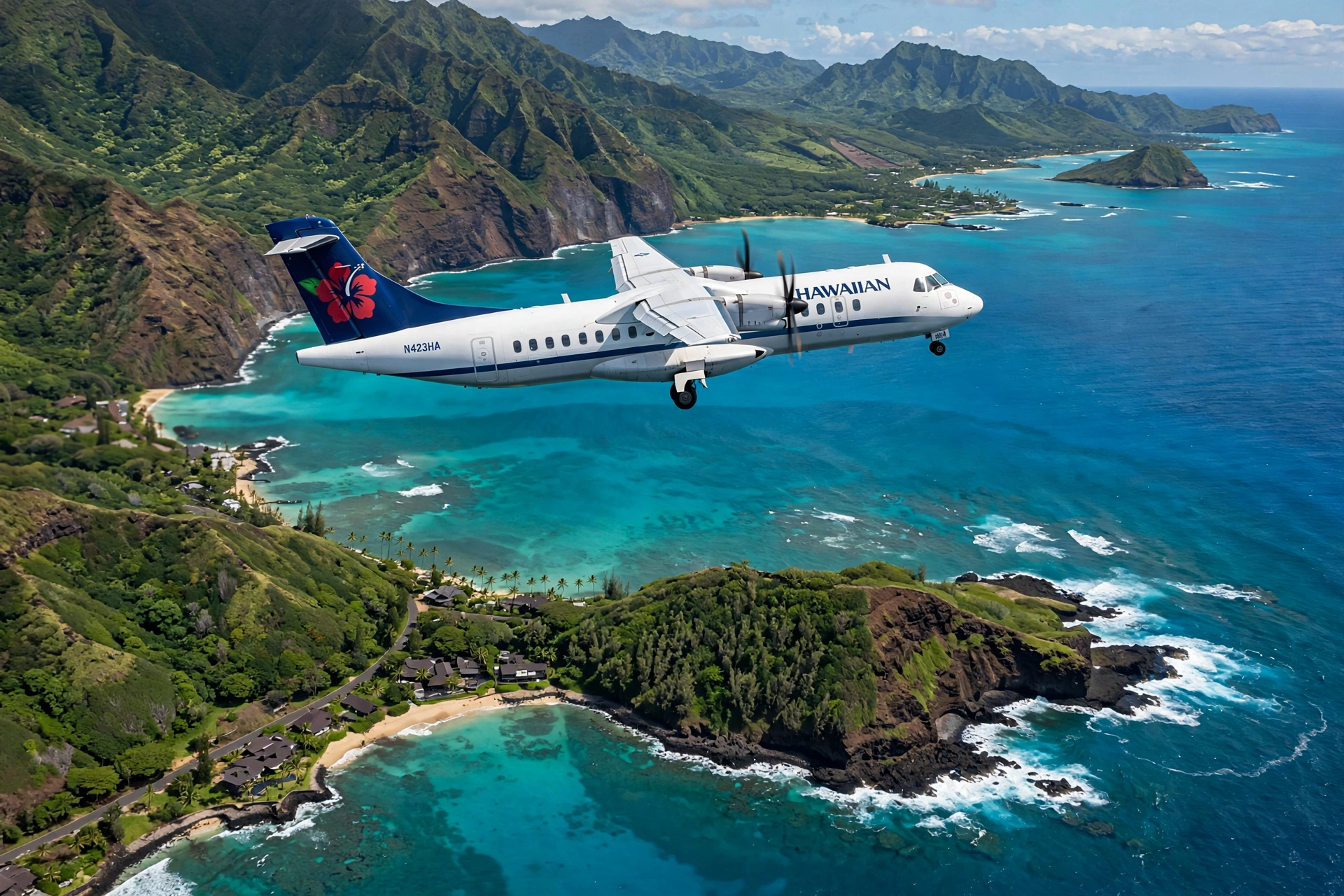
Inter-island flights are the backbone of travel between the Hawaiian Islands. Dozens of departures run daily between the major airports, and the flights themselves are short, typically twenty to forty-five minutes in the air. Two airlines operate jet service between the main islands: Hawaiian Airlines, the state’s longtime flag carrier, and Southwest Airlines, which entered the inter-island market with competitive fares. A third carrier, Mokulele Airlines, flies smaller turboprop aircraft to the state’s smaller airports, including Lānaʻi, Molokaʻi, Kapalua in West Maui, Hana, and Waimea on the Big Island.
The main airports to know are Daniel K. Inouye International Airport in Honolulu (HNL) on Oʻahu, Kahului Airport (OGG) on Maui, Ellison Onizuka Kona International Airport at Keāhole (KOA) on the west side of the Big Island, Hilo International Airport (ITO) on the east side of the Big Island, and Līhuʻe Airport (LIH) on Kauaʻi. These five handle nearly all jet traffic. The smaller airports, Lānaʻi Airport (LNY), Molokaʻi Airport (MKK), and Kapalua Airport (JHM), are served by Mokulele’s nine-seat Caravans, which makes for a scenic low-altitude flight.

A few practical points make inter-island flying smoother. Book early for the lowest fares, and compare both Hawaiian and Southwest, since pricing swings with demand. Agricultural inspection applies to flights leaving Hawaiʻi for the mainland, but for flights between islands the process is simpler: standard TSA screening applies, and baggage rules match the airline’s normal domestic policy. Give yourself more time than the short flight suggests, because you still need to deplane, collect bags, and pick up a rental car on the other end. A thirty-minute flight easily consumes three hours door to door.
If you are visiting multiple islands, consider an open-jaw itinerary: fly into one island and home from another, rather than backtracking. Many visitors also stack islands by geography, pairing Maui with Lānaʻi or Molokaʻi, or Oʻahu with Kauaʻi, to keep connections simple. Early morning flights are the most reliable, since delays compound through the day, and trade-wind weather can slow afternoon operations.
Airport Tips
- HNL (Honolulu): The state’s busiest airport and the main international gateway. Inter-island flights depart from a separate terminal area, so follow signs carefully on arrival.
- OGG (Kahului): Maui’s main airport. Rental car facilities are consolidated and efficient, but lines peak midday.
- KOA (Kona): An open-air airport on the Big Island’s west side. The layout is spread out, so wear comfortable shoes and expect some walking in the sun.
- ITO (Hilo): Smaller and quieter, serving the Big Island’s east side. A good choice if your plans center on Hawaiʻi Volcanoes National Park.
- LIH (Līhuʻe): Kauaʻi’s only commercial airport, minutes from most south shore resorts.
- LNY, MKK, JHM: Tiny airports served by nine-seat aircraft. Arrive early, pack light, and enjoy the view.
Inter-Island Ferries
Hawaiʻi has far less ferry service than most visitors expect. There is exactly one scheduled passenger ferry route in the state: Expeditions operates between Māʻalaea Harbor on Maui and Mānele Harbor on Lānaʻi. The crossing takes about 1 hour 15 minutes, runs multiple round trips daily, and carries passengers only, no vehicles. It is a practical way to day-trip to Lānaʻi from Maui or to reach Lānaʻi without flying, and the ride itself offers good views of the islands and, in winter, humpback whales.
There is currently no regular passenger ferry between Maui and Molokaʻi. A ferry ran that route for decades but shut down, and travelers now fly between the islands on small commuter aircraft. Maui County has announced plans for a publicly supported ferry system that would eventually serve both Lānaʻi and Molokaʻi, but the Molokaʻi route is still years from reality, with new vessels yet to be designed and built. Treat any future ferry as a plan, not a promise, when scheduling a trip.
What does not exist, and has never existed in the modern era, is a car ferry between any Hawaiian islands, or ferry service connecting Oʻahu, Kauaʻi, or the Big Island to anywhere else. If an itinerary requires a rental car on two islands, that means two separate rentals. The failed Hawaiʻi Superferry experiment, which briefly ran large car-carrying vessels before shutting down, is a reminder that inter-island ferry service in these waters is harder than it looks.

Ferry facts: The Maui to Lānaʻi ferry is passenger-only, so you cannot bring a rental car. Book Lānaʻi rental cars and shuttles separately and in advance, since the island’s vehicle fleet is tiny. Ferry schedules can change with ocean conditions, so confirm your sailing before you go.
Rental Cars
For most visitors on most islands, a rental car is the single most important transportation decision of the trip. Outside of Waikīkī and urban Honolulu, Hawaiʻi’s attractions are spread out, bus service is thin or nonexistent, and rideshares are scarce in rural areas. A rental car buys freedom: sunrise at Haleakalā, the Road to Hāna, the Kona coffee belt, and Waimea Canyon are all effectively car-only destinations.
Book as early as you can, especially for travel during holidays, spring break, and summer. Hawaiʻi’s rental fleets are finite, island inventories are small, and prices spike when demand surges. This is doubly true on Molokaʻi and Lānaʻi, where the rental fleets number in the dozens rather than the thousands and can sell out weeks ahead. If your dates are flexible, compare rates across arrival days, since weekend pickups often cost more.
What Kind of Vehicle
A standard sedan handles nearly everything a typical visitor does: highways, resort areas, beaches, and national parks are all paved and well maintained. Four-wheel drive is only necessary for specific unpaved destinations, such as the road to the summit of Mauna Kea, which rental companies often require to be driven in a 4WD vehicle, or the back roads of Molokaʻi’s and Lānaʻi’s west ends. Even then, read your rental agreement first. Many contracts prohibit driving on unpaved roads entirely, and violating the contract can void your coverage.
Convertibles are popular and the weather invites them, but they come with trade-offs: limited trunk security and higher rates. Minivans and SUVs suit families and groups with gear. Whatever you choose, inspect the vehicle at pickup, photograph any existing damage, and confirm the fuel policy before leaving the lot.
Age, Insurance, and Cost
Most major rental companies rent to drivers twenty-one and older, with a daily young-driver surcharge for renters under twenty-five. Requirements vary by company and island, so verify age policy when you book rather than at the counter. On insurance, check what you already carry before buying the counter add-ons: many personal auto policies extend to rental cars, and many credit cards include secondary rental coverage. Hawaiʻi also adds the usual round of taxes and surcharges, so the advertised daily rate is never the final number.
Gasoline in Hawaiʻi is typically the most expensive in the nation, thanks to shipping costs and taxes. Budget accordingly, and fill up before heading into remote areas: there is one gas station on Lānaʻi, a handful on Molokaʻi, and long empty stretches on the Big Island. Returning the car with the agreed fuel level avoids steep refueling charges.

Alternatives to Traditional Rental
Peer-to-peer car sharing platforms operate in Hawaiʻi and can offer more vehicle variety or better availability during sellouts, though pickup logistics vary and airport pickup rules differ by island. Hotel shuttles, resort shuttles, and private transfer companies cover airport transfers in the main resort areas. Taxis are available at airports but are expensive for longer distances. Rideshare apps work well in Honolulu, Kahului, Kona, and Līhuʻe, but wait times grow long outside town centers and late at night.
Public Transit by Island
Public transit in Hawaiʻi ranges from genuinely useful to nonexistent, depending on the island. Set expectations by island before you go.
Oʻahu: TheBus
Oʻahu has the state’s only comprehensive bus system. TheBus covers the island with dozens of routes, including service to Waikīkī, downtown Honolulu, Pearl Harbor, Hanauma Bay, and the North Shore, though cross-island trips take a while. Fares are affordable, paid with the HOLO reloadable smart card, and buses have bike racks. For visitors staying in Waikīkī without a car, TheBus plus walking covers a surprising amount of the island. Paratransit service is available for eligible riders with disabilities.
Big Island: Hele-On
Hawaiʻi County’s Hele-On bus runs limited routes connecting Hilo, Kona, Waimea, and smaller towns. Service is infrequent, with long gaps between buses, and routes are designed around residents commuting rather than tourists sightseeing. It can work for a patient traveler moving between the island’s two main towns, but it is not a substitute for a rental car for exploring the island.
Kauaʻi: The Kauaʻi Bus
The Kauaʻi Bus runs a handful of routes along the main highway corridor, connecting Līhuʻe, Kapaʻa, Hanalei, and the west side towns. Like Hele-On, it runs infrequently and serves commuters first. Visitors can use it for simple point-to-point trips along the east side, but reaching trailheads, the North Shore’s far end, or Waimea Canyon requires a car.
Maui: Maui Bus
Maui County’s bus system connects Kahului, Wailuku, Kīhei, Lahaina, and Upcountry towns on commuter-oriented schedules. It is useful for workers and for visitors making simple town-to-town trips, but it does not serve Haleakalā, the Road to Hāna, or resort beaches on a sightseeing-friendly schedule.
Molokaʻi and Lānaʻi: No Public Transit
Neither Molokaʻi nor Lānaʻi has a fixed-route public bus system. Getting around means a rental vehicle, a hotel or private shuttle, walking within the small towns, or for Lānaʻi, the ferry-plus-shuttle combination from Maui. Plan accordingly and reserve vehicles well in advance.

Honolulu Skyline Rail
Skyline is Honolulu’s driverless, elevated rail system and the only passenger rail line in the state. The first segment opened from East Kapolei to Aloha Stadium, and a second segment extended service through Pearl Harbor and Daniel K. Inouye International Airport to the Middle Street transit center, bringing the system to thirteen stations. A third segment now under construction will carry the line into downtown Honolulu and the civic center area.
For visitors, Skyline’s most useful feature is the airport connection: travelers can now ride the train between the airport and points west, including Aloha Stadium, with transfers to TheBus for onward travel. Trains are fully automated, stations have platform screen doors, and fares use the same HOLO card as TheBus, with free transfers between the two systems. Service runs daily with trains every ten minutes or better during most hours.
Skyline does not serve Waikīkī, downtown Honolulu hotels, or the east side of Oʻahu yet. Visitors heading to Waikīkī from the airport still do best with a shuttle, taxi, rideshare, or TheBus. Check the current operating map before planning around the train, since the system is still growing and schedules evolve as new segments open.
Driving Tips
Driving in Hawaiʻi will feel familiar to anyone licensed in the United States: traffic keeps right, signs are in English, and the rules of the road match the mainland with a few local twists. Speed limits top out at sixty miles per hour on the interstate freeways around Honolulu, with most highways posted at forty-five to fifty-five and rural roads lower. Enforcement is active, and fines are steep.
The most important local hazard is water. Flash floods can turn a dry gulch into a raging stream in minutes, especially on the windward sides of the islands. Never attempt to drive through flooded roadways: the depth is deceptive, the current is stronger than it looks, and cars are swept away every year. If water covers the road, turn around. Heavy rain also brings rockfalls and landslides on cliff-side highways like the Road to Hāna, the Kamehameha Highway on Oʻahu’s windward side, and the Hāmākua Coast.

One-lane bridges are common on scenic rural highways, most famously along the Road to Hāna, where more than fifty of them slow traffic to a crawl. The etiquette is simple: yield to the vehicle already on the bridge, and on narrow stretches, the driver with the turnout on their side pulls over. Drive these roads slowly, expect oncoming traffic around blind curves, and use the turnouts to let faster local traffic pass. Nothing sours a local’s day like a rental car holding up a line of commuters.
A few more practical notes. Parking in Honolulu and resort areas is tight and expensive: read every sign, since tow-away zones are strictly enforced. Never leave valuables visible in a parked car, especially at trailheads and beach lookouts, where break-ins are a known problem. When parking at beaches, take only what you need. Seatbelt use is mandatory for all passengers, and handheld phone use while driving is illegal. Motorcycles and mopeds share the roads, particularly in Waikīkī, so check mirrors before changing lanes. And when a local driver flashes a shaka or waves you through, that is the island’s version of a thank-you: the driving culture here is generally relaxed, and patience is rewarded.
Accessibility
Travelers with disabilities can navigate Hawaiʻi, but the experience varies by island and advance planning pays off. Airports throughout the state provide wheelchair assistance through the airlines: request it when booking and confirm before departure. All commercial airports meet federal accessibility standards, with accessible restrooms, seating areas, and transportation connections.
On the ground, TheBus on Oʻahu is fully wheelchair accessible, with lifts or ramps on every bus and priority seating, and the paratransit system provides door-to-door service for eligible riders. Skyline stations have elevators at every stop. Rental car companies can provide vehicles with hand controls if you reserve them well in advance, though availability on the smaller islands is limited, so call the local office directly rather than relying on the national reservation line.
Hotels and resorts in the main visitor areas generally offer accessible rooms and pool lifts, and many state beach parks have beach-accessible wheelchairs available. Trail and natural-area accessibility is limited: most hiking trails, waterfalls, and rugged coastal lookouts are not wheelchair accessible. The National Park Service sites, including Hawaiʻi Volcanoes and Haleakalā, publish detailed accessibility guides worth reading before you go. For the inter-island ferry to Lānaʻi, contact the operator ahead of time to discuss boarding assistance and wheelchair stowage.

Frequently Asked Questions
Do I need a rental car in Hawaiʻi?
On every island except Oʻahu, yes for most visitors. Maui, Kauaʻi, the Big Island, Molokaʻi, and Lānaʻi have limited or no public transit, and their sights are spread out. On Oʻahu, you can manage without a car if you stay in Waikīkī or Honolulu and use TheBus, Skyline, and rideshares, renting a car only for day trips to the North Shore or windward side.
How do I travel between islands?
By air, in nearly all cases. Hawaiian Airlines and Southwest Airlines fly jets between Honolulu, Kahului, Kona, Hilo, and Līhuʻe, while Mokulele Airlines flies smaller turboprops to Lānaʻi, Molokaʻi, Kapalua, Hana, and Waimea. Flights are short, usually under an hour gate to gate.
Is there a ferry between the Hawaiian Islands?
Only one scheduled route exists: the passenger ferry between Maui (Māʻalaea Harbor) and Lānaʻi (Mānele Harbor). There is no ferry to Oʻahu, Kauaʻi, or the Big Island, and no current ferry between Maui and Molokaʻi. Maui County has announced plans for future public ferry service, but it is still in the planning stages.
Can I take my rental car on a ferry between islands?
No. The Maui to Lānaʻi ferry is passenger-only and carries no vehicles. There are no car ferries between any Hawaiian islands. You need a separate rental car on each island you visit.
Does Hawaiʻi have public transportation?
Oʻahu has a real bus network (TheBus) plus the Skyline rail line. The Big Island, Kauaʻi, and Maui have limited commuter-oriented bus systems. Molokaʻi and Lānaʻi have no public transit at all.
What is Skyline?
Skyline is Honolulu’s driverless elevated rail system. It currently runs from East Kapolei through Aloha Stadium, Pearl Harbor, and the airport to Middle Street, with an extension into downtown under construction. It uses the same HOLO fare card as TheBus.
Do I need a four-wheel-drive vehicle?
For typical sightseeing, no. A standard car handles all paved highways, resort areas, and national parks. Four-wheel drive matters only for specific unpaved destinations like the Mauna Kea summit road or the back roads of Molokaʻi and Lānaʻi, and many rental contracts restrict off-pavement driving regardless of vehicle type, so read the agreement.
Which side of the road do they drive on in Hawaiʻi?
The right side, the same as the rest of the United States. Road signs are in English and use miles per hour.
Related Guides
- Maui Transportation: rental cars, the ferry to Lānaʻi, and driving the Valley Isle.
- Oʻahu Transportation: TheBus, Skyline rail, and getting around Honolulu without a car.
- Kauaʻi Transportation: rental cars and the island’s limited bus service.
- Big Island Transportation: covering an island larger than all the others combined.
- Molokaʻi Transportation: small fleets, advance booking, and no public transit.
- Lānaʻi Transportation: the ferry, 4WD rentals, and hotel shuttles.
- Hawaiʻi Weather: statewide seasons, microclimates, and packing.
- Best Time to Visit Hawaiʻi: when crowds, prices, and weather align.
A Final Note
Transportation in Hawaiʻi rewards the traveler who plans the skeleton of the trip early and leaves the details loose. Book the inter-island flights and rental cars first, since those are the constrained resources, then let each island’s pace set the rest. Distances are short, the scenery does most of the work, and the slowest road on the itinerary is often the one you will remember best.