Hawaii Rice and Spam: History, Spam Musubi & Where to Eat It

Rice and Spam is Hawaii’s unofficial national dish: born of wartime necessity, raised by plantation-era ingenuity, and now a point of cultural pride. Hawaiians eat more than 7 million cans of Spam per year: more per capita than any other U.S. state. This guide covers the history, the iconic dishes, where to eat them, and how to make them at home.
Why Hawaii Loves Spam: The History
Spam arrived in Hawaii during World War II, shipped in vast quantities to feed military personnel across the Pacific. It was shelf-stable, affordable protein when fresh meat was scarce: and after the war, it stayed. Plantation-era families, many of Japanese, Filipino, Portuguese, and Korean descent, folded Spam into their cooking: fried rice, saimin, breakfast plates. What began as necessity became identity. Today Spam is celebration food: served at parties, fundraisers, and the annual Spam Jam festival in Waikīkī.
Spam in Hawaii: The Dishes That Define It
| Dish | What it is | Where to find it | Typical price |
| Spam musubi | Grilled Spam on rice, wrapped in nori | Everywhere: 7-Eleven to restaurants | $2-4 |
| Spam fried rice | Diced Spam with rice, egg, vegetables | Plate lunch spots, diners | $10-14 plate |
| Spam and eggs | Fried Spam with eggs and rice | Breakfast joints, McDonald’s Hawaii | $8-12 |
| Spam saimin | Noodle soup with Spam slices | Saimin shops, diners | $9-13 |
| Spam katsu | Breaded, fried Spam cutlet | Plate lunch, bento shops | $10-14 plate |
The musubi is the icon, but the fried rice is the everyday workhorse: and the breakfast plate (Spam, eggs, rice) is what half the state eats before work.

Spam Musubi: The Icon
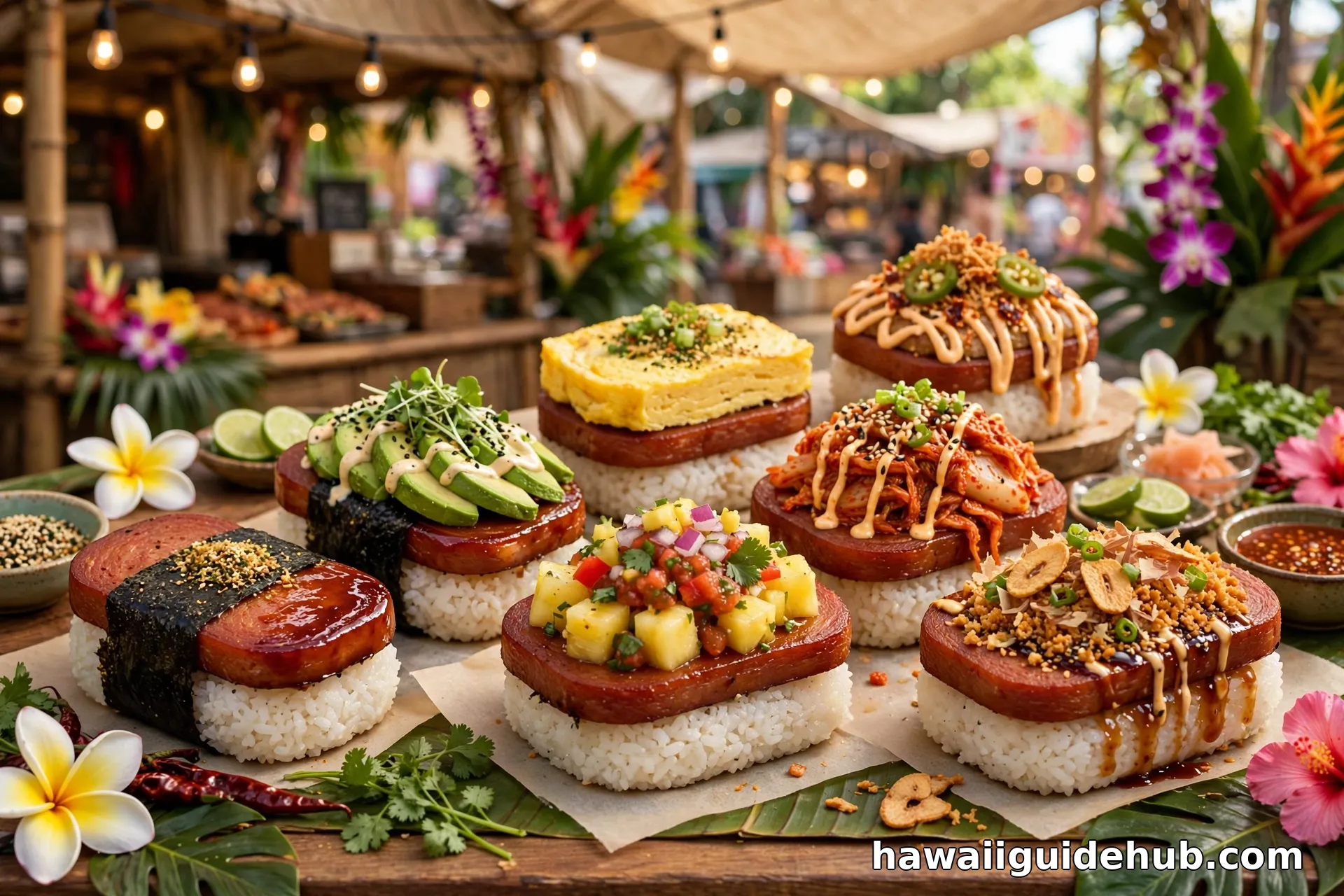
Spam musubi: a slice of grilled Spam (often glazed with a sweet shoyu-sugar sauce) on a block of seasoned rice, wrapped with nori. It descends from Japanese onigiri, reimagined with American canned meat by plantation-era cooks. Competing origin stories credit Barbara Funamura (Kauaʻi) or Mitsuko Kaneshiro (Honolulu). Today it is everywhere: gas stations, 7-Eleven, school cafeterias, high-end riffs by celebrity chefs. The classic costs $2-4: the best value snack in Hawaii.
Spam Jam and Spam Culture
Waikīkī’s annual Spam Jam festival (usually late April/early May) draws tens of thousands: restaurants compete with creative Spam dishes, from Spam musubi to Spam loco moco to Spam desserts. Hawaii even has its own Spam varieties: including flavors sold only in the islands. National Spam Musubi Day (August 8) is celebrated with gusto. For visitors, the festival is the most fun possible introduction: for locals, it is a point of pride that the mainland finds baffling.
How to Make Spam Musubi at Home
You need: a can of Spam, short-grain rice, nori sheets, shoyu, sugar, and mirin (or a musubi mold, though the empty Spam can works as a mold). Slice Spam into 8-10 slabs. Fry until crisp-edged. Simmer shoyu, sugar, and mirin into a glaze; toss the Spam in it. Press warm rice into the mold (or can) to form blocks. Lay a Spam slice on each rice block, wrap with a nori strip. Eat warm. The whole operation takes 20 minutes: and homemade beats store-bought by a mile.
Beyond Musubi: The Full Spam Repertoire
Spam fried rice: the weeknight hero. Spam and eggs with rice: the breakfast of champions (McDonald’s in Hawaii serves it). Spam saimin: comfort in a bowl. Spam katsu: breaded and fried like tonkatsu. Spam loco moco: on rice with gravy and egg. Spam wontons, Spam sushi rolls, Spam nachos at sports bars. Portuguese sausage gets the glory, but Spam is the utility player: it goes in everything, and everything is better for it. Well, almost everything.
The Economics of Spam in Hawaii
Spam endures partly because it is cheap protein: a can costs a few dollars and feeds a family. In a state with the nation’s highest cost of living and priciest groceries, affordable shelf-stable protein matters. Spam’s price stability (no fishing seasons, no fuel surcharges on the boat) makes it budget bedrock. Food insecurity is real in Hawaii: Spam’s role as affordable nutrition is not just cultural, it is practical. The pride is real, but so is the economics.
Rice: The Other Half of the Equation
Spam gets the glory, but rice is the foundation: and in Hawaii, rice is serious business. Short-grain or medium-grain rice, cooked fresh, slightly sticky: the kind that holds a musubi together. Hawaii’s rice culture comes from Japanese, Chinese, Filipino, and Korean plantation workers, for whom rice was the center of the meal. A proper musubi uses warm, freshly cooked rice: cold rice crumbles. The rice-to-Spam ratio matters: too much rice drowns the Spam; too little and it falls apart. The masters make it look effortless.
The Plantation Story
To understand Spam in Hawaii, understand the plantations. From the mid-1800s to the late 1900s, sugar and pineapple plantations imported workers from Japan, China, Portugal, the Philippines, Korea, and Puerto Rico. They lived in camps, cooked communally, and shared food across cultures: Japanese rice met Portuguese sausage met Filipino adobo met American Spam. Plate lunch, saimin, musubi: all plantation food. Spam was the affordable protein that fit every tradition. The plantation era ended; the food became Hawaiian.
Where to Buy the Best Musubi
7-Eleven: the baseline, available 24/7, surprisingly decent. Musubi specialty shops (like Musubi Cafe Iyasume in Honolulu): the connoisseur’s choice, dozens of varieties. Grocery delis (Foodland, Times): solid and fresh. Plate lunch spots: musubi as a side. Gas stations on road trips: essential fuel. Farmers markets: gourmet riffs. The rule: fresh-made beats pre-packaged, warm beats cold, and the best musubi is the one in your hand right now.
Video: How to Make Spam Musubi Like Hawaii
From can to musubi: the technique, step by step.
Frequently Asked Questions About Rice and Spam in Hawaii
Why do Hawaiians eat so much Spam?
WWII military supply made it abundant and cheap; plantation-era families made it delicious. It stuck: over 7 million cans per year.
What is spam musubi?
Grilled Spam on a block of rice, wrapped in nori seaweed: Hawaii’s iconic handheld snack, $2-4 everywhere.
Is Spam popular in Hawaii?
Enormously: the highest per-capita consumption of any U.S. state, its own festival, and deep cultural pride.
Where can I try spam musubi?
Everywhere: 7-Eleven, Foodland, gas stations, plate lunch shops, and restaurants statewide. Fresh-made beats pre-packaged.
When is Spam Jam?
Usually late April or early May in Waikīkī: check the year’s dates before planning around it.
Spam’s Critics (and the Chefs Who Answer Them)
Not everyone in Hawaii loves Spam: as processed food, it draws criticism from health and local-food advocates. Some chefs make house-made “Spam” from quality pork: a quiet rebellion. Others argue the real tradition is resourcefulness, not the can itself. The honest position: Spam is high in sodium and preservatives; it is not health food. But food is also culture, memory, and identity: and dismissing Spam dismisses the plantation families who made it delicious. Eat it joyfully, occasionally, and with rice.
Spam Varieties: Beyond the Classic
Hawaii gets Spam varieties the mainland does not: and limited editions appear regularly. Teriyaki Spam, jalapeño Spam, bacon Spam, Portuguese sausage Spam (a local favorite), and low-sodium versions all have their partisans. For musubi, classic or teriyaki are the traditional picks; for fried rice, any variety works. Collectors hunt limited editions. Visitors: bring a can home as the most authentically Hawaiian souvenir that fits in a carry-on (it is allowed: it is canned).
How many cans of Spam does Hawaii eat?
Over 7 million cans per year: the highest per-capita consumption of any U.S. state.
What does spam musubi taste like?
Salty-sweet glazed Spam, soft seasoned rice, chewy nori: savory, satisfying, and addictive. The glaze is the difference-maker.
Spam Across the Pacific
Hawaii is not alone: Spam is beloved across the Pacific. Guam eats more Spam per capita than anywhere on Earth. South Korea’s budae jjigae (army stew) was born of U.S. military Spam. The Philippines’ Spamsilog is a breakfast staple. Okinawa, Saipan, American Samoa: all Spam country. The pattern is the same everywhere: American military supply met local ingenuity, and Spam became comfort food. Hawaii’s version is just the most famous: and the most musubi-shaped.
A Visitor’s Spam Itinerary
Day 1: 7-Eleven musubi for the baseline. Day 2: a plate lunch spot’s Spam fried rice. Day 3: a musubi specialty shop for the gourmet riffs. Day 4: Spam and eggs breakfast, local style. Day 5: grocery store Spam varieties to take home. If your trip coincides with Spam Jam, clear your schedule. Total cost: under $50. Total cultural education: priceless. You will return home with strong opinions about canned meat: this is normal.
Can I bring Spam home from Hawaii?
Yes: canned Spam is allowed in carry-on and checked bags. Limited-edition Hawaii flavors make great souvenirs.
Is spam musubi served warm or cold?
Best warm and fresh: the rice is soft and the glaze is sticky. Pre-packaged musubi is room temperature and still good.
Musubi Variations Worth Trying
Beyond the classic: teriyaki Spam musubi (glazed), Spam and egg musubi (breakfast in a wrap), kimchi Spam musubi (Korean-Hawaiian fusion), Portuguese sausage musubi (the other plantation meat), tuna salad musubi, avocado Spam musubi, and the “bomb”: Spam, egg, and everything. Specialty shops offer dozens. The purist’s position: classic Spam, shoyu glaze, nori, rice. The adventurer’s position: try them all. Both positions are correct.
Musubi Etiquette
Eat it with your hands: it is finger food. Unwrap the nori if it is separately packaged (to keep it crisp) and wrap just before eating. Do not refrigerate and eat cold if you can avoid it: warm it slightly. Share: musubi is social food, made in batches for gatherings, beach days, and road trips. And if someone offers you a homemade musubi, accept it: it is a gesture of aloha, and refusing is worse than any dietary rule.
The Future of Spam in Hawaii
Spam in Hawaii is not fading: it is evolving. Chefs elevate it; festivals celebrate it; younger generations embrace it ironically and then sincerely. Plant-based Spam alternatives have appeared: the reception is mixed but curious. What endures is the deeper story: resourcefulness, cultural fusion, and making delicious food from humble ingredients. As long as Hawaii values those things, rice and Spam will be on the table.
Spam Musubi vs. Onigiri: Cousins, Not Twins
Spam musubi descends from Japanese onigiri (salted rice, often with filling, wrapped in nori): but they are distinct. Onigiri is typically triangular, with the filling inside the rice: umeboshi, salmon, tuna mayo. Musubi is rectangular, with the Spam on top of the rice, nori wrapped around. The difference reflects the adaptation: plantation cooks used what they had (Spam, the Spam can as a mold) and made something new. Calling musubi “Spam sushi” misses the point: it is not sushi, it is musubi, and the distinction matters to people who grew up with both.
Cooking Spam: Techniques That Matter
Spam is pre-cooked: you are heating and browning, not cooking through. Slice 1/4-inch thick: thinner crisps better. Fry in a dry nonstick pan: Spam renders its own fat. Get the edges caramelized: the Maillard crust is where the flavor lives. Glaze at the end: shoyu-sugar, teriyaki, or gochujang for heat. Drain on paper towels. For fried rice, dice small and crisp hard before adding rice. For saimin, slice thin and add at the end. The universal rule: brown it well. Pale Spam is a missed opportunity.
Spam Musubi for Beginners: Your First Bite
Never had Spam? Start with a fresh musubi from a specialty shop, not a gas station: the difference is real. Expect salty, sweet, savory, and chewy in one handheld package. The nori should be crisp, the rice warm and tender, the Spam caramelized at the edges with a sticky glaze. If you are skeptical about canned meat, the musubi is the argument that wins: it has converted millions. Eat it within an hour of buying for the full experience. And then, inevitably, buy a second one.
Try the musubi from a 7-Eleven at least once: then try a chef’s riff at Spam Jam. Both are Hawaii. For more local food culture, see Hawaii’s best late-night eats, malasadas, and Oʻahu’s best restaurants.