Why Is Kauai’s Dirt Red? The Island’s Rust-Colored Soil Explained

Kauai’s dirt is famously, improbably red: rust-colored roads, crimson canyon walls, shoes that never quite come clean. It is not paint and not a trick of the light. It is rust, literal iron oxidation, the result of five million years of rain falling on iron-rich volcanic rock. This guide explains the chemistry, where the red shows best, and how to visit without ruining your luggage.
This is the single complete guide to why Kauai’s dirt is red. It covers the iron-oxidation chemistry, why Kauai is redder than the other islands, Waimea Canyon and the red dirt waterfall, the soil color decoder, plantation history in red soil, practical tips for the stains, and FAQs. Everything about Kauai’s red dirt lives on this one page.
The Short Answer: Kauai Is Rusting
Hawaii’s volcanic basalt is rich in iron. On young islands like the Big Island, that iron is still locked inside dark, fresh lava rock. But Kauai is about five million years old, the oldest of the main islands, and it has endured millions of years of warm rain. Water and oxygen attack the iron minerals, converting them to iron oxides: the same chemistry as rust on a car. Per University of Hawaii CTAHR soil research, Kauai’s oldest soils are so rich in iron and aluminum oxides that aluminum companies once investigated mining them as ore. The red is not a surface stain; the soil is rust all the way down.
Rainfall multiplies the effect. Kauai is one of the wettest places on Earth, and warm, humid conditions weather lava into clay and oxides fast: the rock is stripped of silica by leaching rainwater, leaving the insoluble red residue of iron and aluminum oxide. Drier islands rust more slowly. Kauai rusts gloriously.
Soil Color Decoder: What Each Color Means
Kauai’s ground is not one red; it is a palette, and each color is a mineralogical report:
| Color | Mineral behind it | What it tells you | Where on Kauai |
| Brick red | Hematite (iron oxide) | Old, deeply weathered, well-drained soil | Waimea Canyon walls, west-side roads |
| Orange-rust | Goethite (hydrated iron oxide) | Wetter weathering; iron plus water | Road cuts along Hwy 550 |
| Dark brown-black | Fresh basalt, organic matter | Younger surface or rich topsoil | North shore valleys |
| Pale gray-white | Leached silica, coral sand | Beach zones; not volcanic soil at all | Poipu and south-shore beaches |
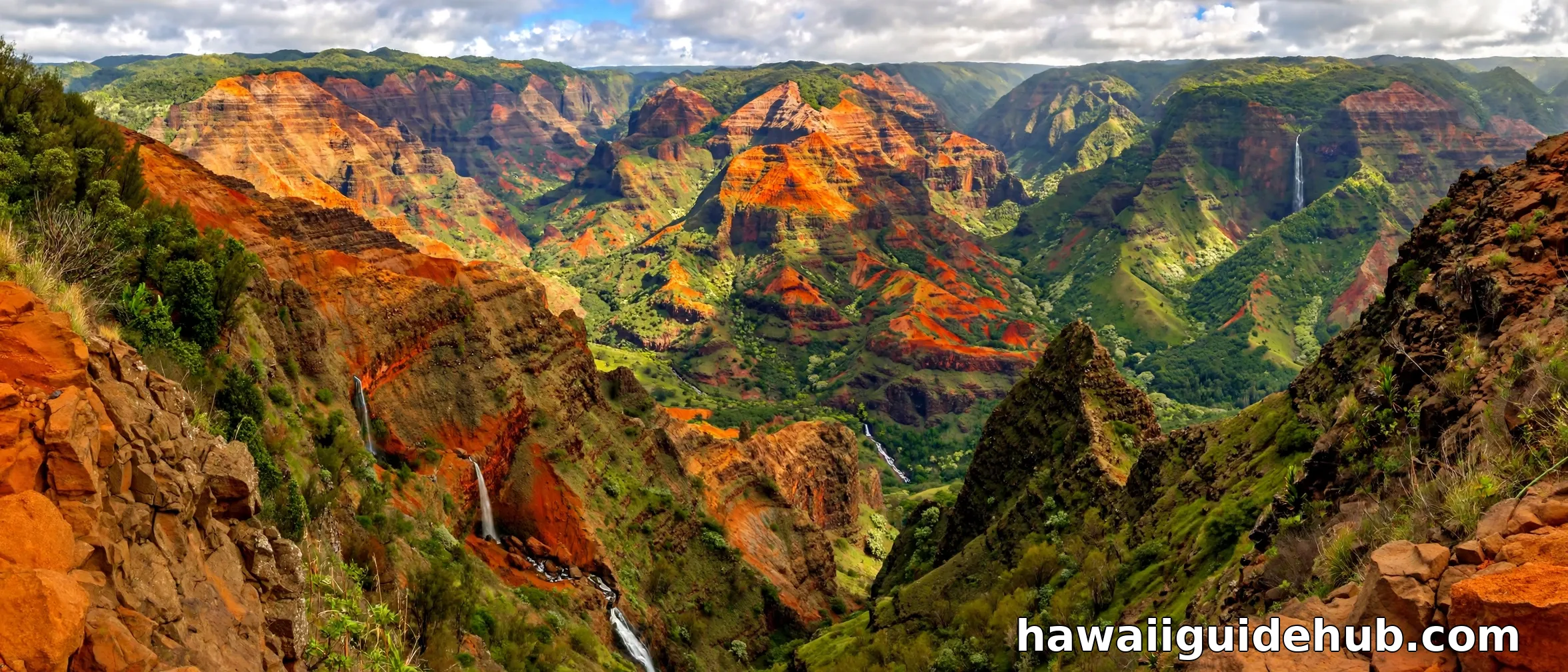
The canyon walls layer these colors like strata because each lava flow weathered under slightly different conditions before the next buried it. See the canyon up close in our Waimea Canyon hiking guide.
Waimea Canyon: The Reddest Place in Hawaii
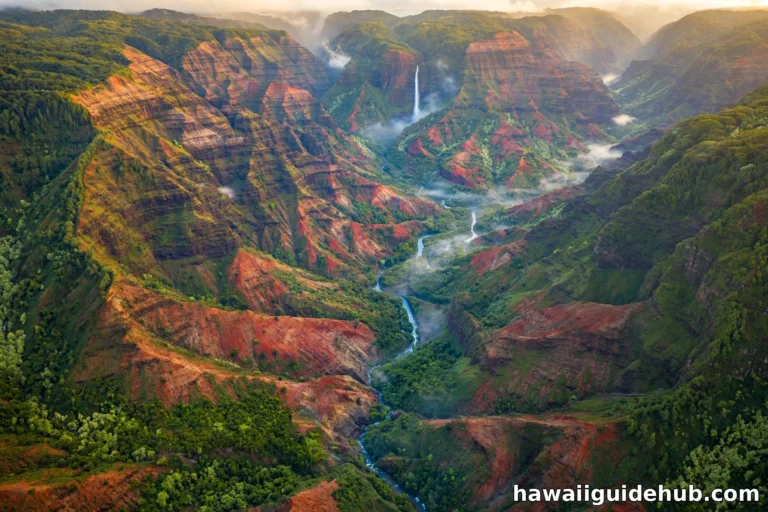
Waimea Canyon, the “Grand Canyon of the Pacific,” is ten miles long and about 3,000 feet deep, and its walls are the island’s rust laid bare. The Waimea River cut through layer upon layer of ancient lava flows, exposing each to air and rain, and every layer rusted at its own pace into bands of red, orange, and maroon. The Hawaiian name Waimea means “reddish water,” for the rust-colored river that runs after heavy rains.
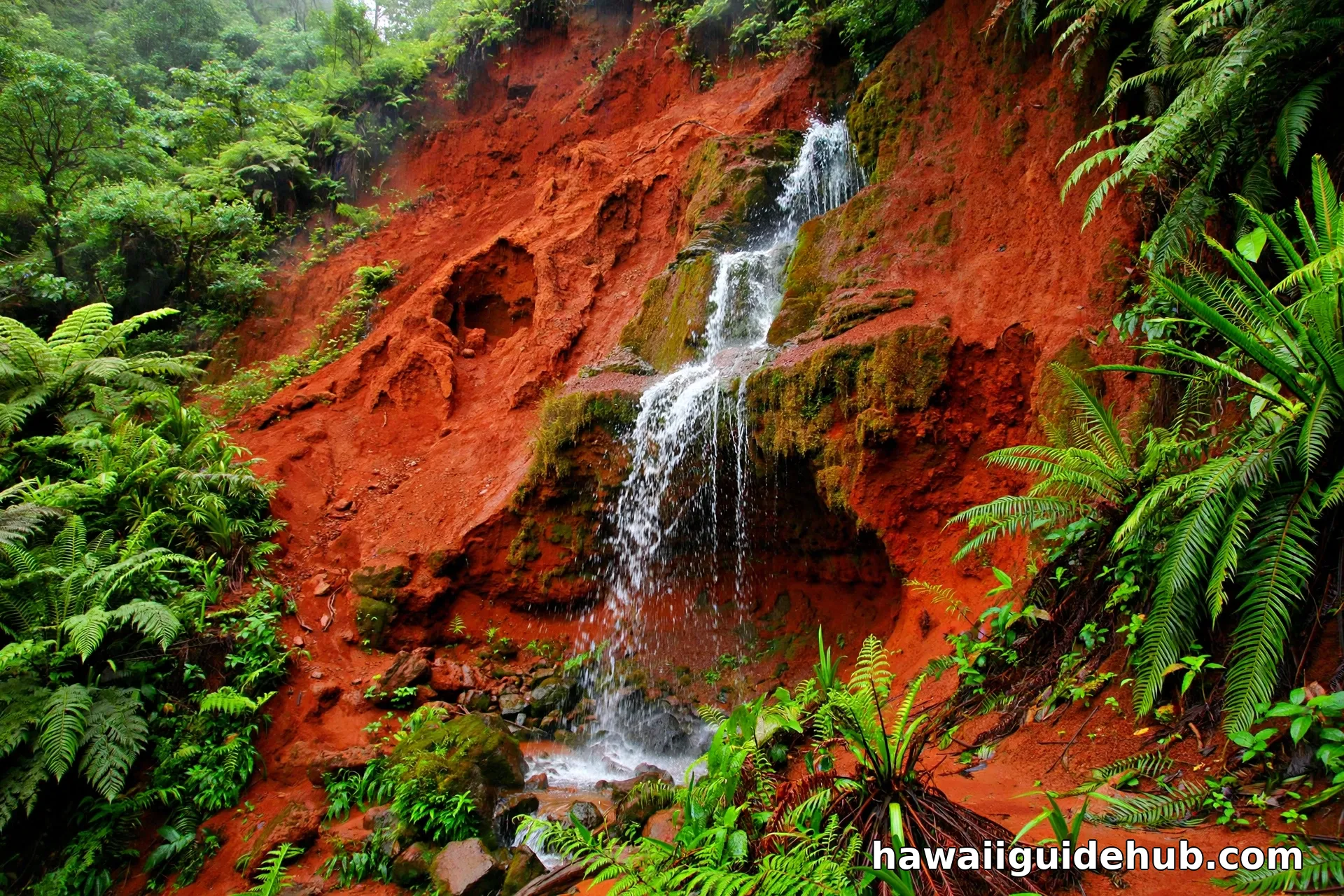
Halfway up Highway 550, the roadside Red Dirt Waterfall pours over a cliff of pure red earth: a small cascade made photogenic entirely by the soil it falls across. It is a five-minute stop and one of the most photographed patches of dirt in the Pacific. For the full island picture, see our Kauai things-to-do guide.
Red Dirt and Sugar: The Plantation Connection
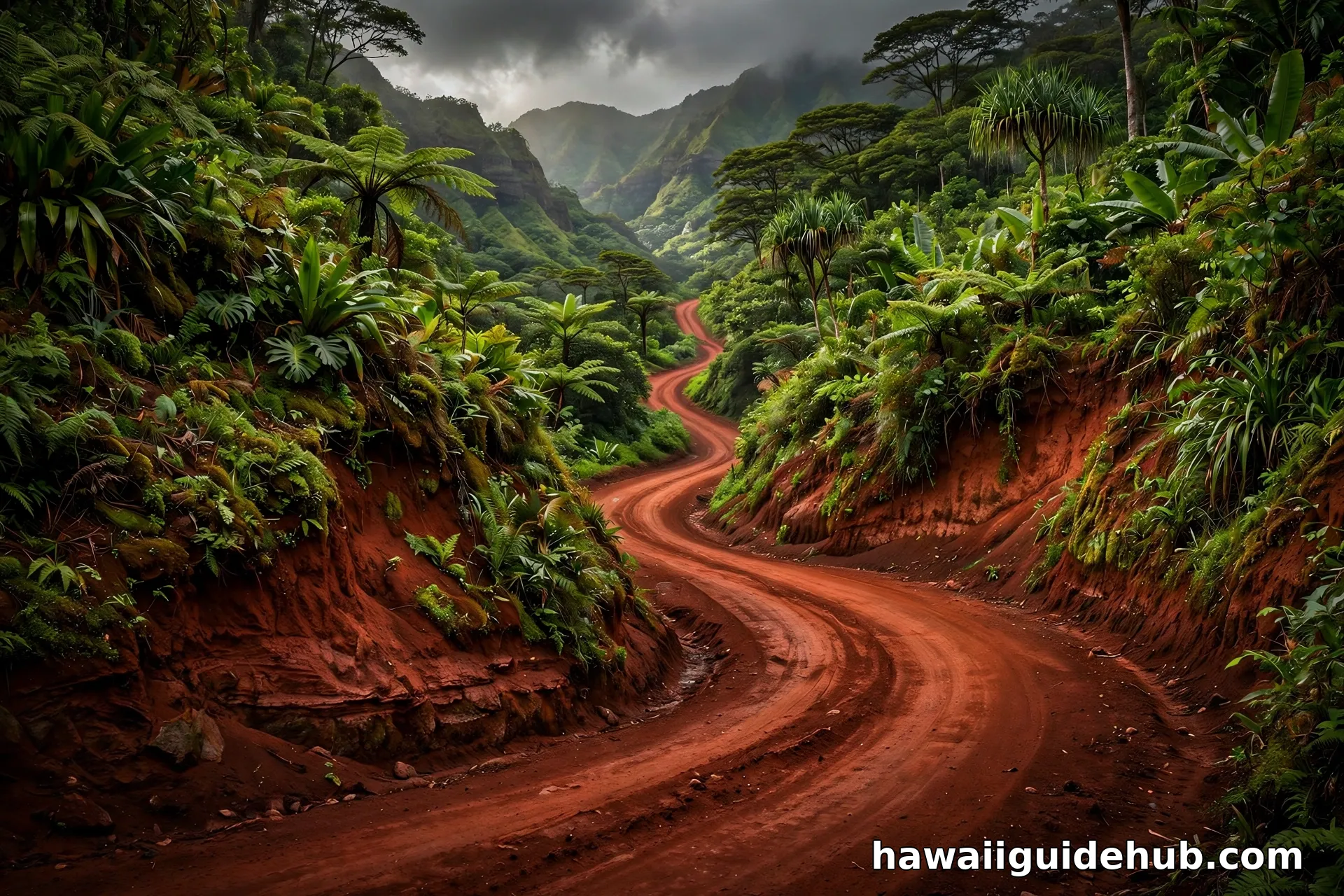
The red soils grew an empire. Kauai’s deeply weathered Oxisols, though low in some nutrients, proved excellent for sugarcane with irrigation and amendment: the fine red clays held water, and the plantation era reshaped the island’s west and south sides into cane fields. The red dirt roads between the fields are plantation roads, and the red dust that coats everything downwind is the same soil. When the last mills closed, the fields went to coffee, seed corn, and pasture, but the dirt stayed red, and the island’s agricultural identity is still written in it.
Living With the Stain: Practical Tips
Kauai’s red dirt stains with commitment. Practical rules from long experience: wear shoes you do not love on canyon hikes and red-dirt roads; the fine iron oxide works into fabric permanently. White rental cars show every splash; nobody minds, but wash it before return to avoid cleaning fees. Keep a towel on the car seat after hikes. If red dirt gets on clothes, rinse cold before it dries; hot water sets iron stains. And embrace it: the red shoes, the red cuffs, the red dust on the dashboard are the most authentic souvenirs Kauai gives, and they cost nothing.
The Five-Million-Year Recipe: How Kauai Rusts Step by Step
The rusting follows a sequence geologists can read like chapters. First, fresh basalt cools with its iron locked in dark minerals like pyroxene and olivine. Second, warm rainwater, slightly acidic from dissolved CO2, attacks those minerals and leaches out silica, the soluble scaffolding of the rock. Third, the iron left behind oxidizes into goethite and hematite, the yellow-brown and brick-red pigments. Fourth, over millions of years, the soil deepens and reddens as the process repeats with every rain. Kauai has simply run this cycle longer than any other main island: the Big Island is still on chapter one, Maui on chapter two, and Kauai is deep into chapter four.
Red Dirt Beyond Kauai: Where Else It Shows
Kauai is the reddest, but the chemistry works everywhere with age and rain. Oahu’s Wahiawa plateau has the famous red Wahiawa soils, classified by soil scientists as Rhodic Eustrutox, some of the reddest agricultural soils in the state. Maui’s central valley and parts of the Big Island’s Hamakua coast show rusty road cuts. But nowhere else combines Kauai’s age, rainfall, and exposed canyon walls into the full spectacle. The other islands have red patches; Kauai is red as an identity.
Kokee and the Highlands: Red Dirt at 4,000 Feet
Drive past the canyon to Kokee State Park and the red follows you up. At 3,000 to 4,000 feet, the red soils meet native ohia and koa forest, and the contrast is startling: crimson earth under emerald canopy, mist drifting through both. The Alakai Swamp, one of the wettest high-elevation bogs on Earth, sits on these same old soils, its stunted vegetation rooted in rust. Hikers on the canyon trails walk through the full sequence in a day: red dirt trailheads, green forest middles, and cliff-edge views back across the red walls. It is the island’s geology arranged as a walk.
The Science of Stains: Why Iron Oxide Never Lets Go
Iron oxide stains because it is a pigment, not dirt. The particles are microscopic, smaller than most fabric weaves, and they carry a slight charge that bonds them to fibers. Water alone will not break that bond; heat sets it permanently by baking the oxide into the material. This is why the cold-rinse rule matters and why the dryer is the point of no return. The same chemistry made red ochre one of humanity’s first paints: Kauai’s dirt is literally paint-grade pigment, which is why it colors everything it touches with such enthusiasm.
Red Dirt in Hawaiian Culture and Story
The red earth, lepo ula, runs through Hawaiian material culture. Red ochre (alaea) was used in traditional medicine, in dyeing kapa cloth, and in ceremony; some was even eaten as a mineral supplement by pregnant women. The red-stained salt of the island, paakai dyed with alaea, is still made and sold today. When Hawaiians named Waimea for its reddish water, they were doing what this whole page does: reading the land’s chemistry and writing it into language. The dirt is not just scenery; it is one of the island’s oldest cultural materials.
The Red Dirt Waterfall: A Roadside Icon
Halfway up Highway 550 sits one of Hawaii’s most photographed patches of earth: a modest waterfall pouring over a cliff of saturated red soil. The falls themselves are small, but the setting is pure Kauai, crimson earth against green ferns, and it has become a mandatory photo stop on the canyon drive. Go after rain, when the falls run fuller and the red is at its most vivid; in dry spells the cascade thins to a trickle but the red cliff still delivers. Park fully off the road, watch for traffic on the narrow shoulder, and keep the stop to ten minutes: the canyon lookouts ahead are the main event.
When the Rivers Run Red: Storm Season
Kauai’s winter storms turn the geology into theater. Heavy rain strips the red soil from the uplands and the rivers run the color of the island’s name: Waimea’s “reddish water” in full flow, waterfalls pouring red-tinted, sediment plumes spreading into the blue ocean at river mouths. It is spectacular from a lookout and a signal to stay out of the water: runoff brings debris and bacteria, and brown-water advisories follow big storms. The red rivers are the island rusting in real time, a few more grains of five-million-year-old soil washing to the sea with every storm.
Watch: Waimea Canyon, the Grand Canyon of the Pacific
Kauai Red Dirt FAQs
Why is Kauai’s dirt redder than the other islands?
Age plus rain. Kauai is the oldest main island, about five million years, so its iron-rich volcanic soils have had the longest to oxidize. Heavy rainfall accelerates the rusting. Younger islands like the Big Island still have dark, fresh basalt that has not had time to rust.
Is the red dirt dangerous?
No. It is just iron oxide, the same chemistry as rust. It stains skin, clothes, and cars, but it is not toxic. The real hazards on red-dirt roads are slippery mud after rain and the cliffs themselves, not the soil chemistry.
What does Waimea mean?
“Reddish water” in Hawaiian, named for the Waimea River running red with eroded soil after heavy rains. The name is the island’s own acknowledgment of its rusting.
Can you get the red stains out of clothes?
Sometimes, if you act fast: rinse in cold water immediately, then treat with a rust remover or lemon juice and salt before washing. Once heat-set in a dryer, iron oxide stains are usually permanent. Pack sacrificial hiking clothes.
Where is the best place to see the red dirt?
Waimea Canyon’s lookouts for the grand scale, the Red Dirt Waterfall on Highway 550 for the roadside photo, and any west-side dirt road after rain for the full immersive experience. For swimming days between, see our Kauai swimming beaches and winter Kauai guide.
Is Kauai’s soil good for farming?
With management, yes. The old red Oxisols are acidic and low in phosphorus and silica, but sugarcane thrived with irrigation, lime, and fertilizer for over a century. Today the same soils grow coffee, taro in the valley bottoms, and seed crops. Per UH CTAHR, these are among the most studied tropical soils in the world.
An Island, Rusting Beautifully
Kauai’s red dirt is time made visible: five million years of rain turning iron to rust, rivers carving the rust into a canyon, and a whole agricultural civilization rising on the red fields. It stains your shoes, colors your photos, and names the island’s great canyon. Walk the canyon rim at sunset when the walls glow their deepest red, stop at the little waterfall on the way up, drive a west-side dirt road with the windows down, and wear the dust home. It washes off the car eventually, and mostly off your shoes. The understanding of why it is red, five million years of rain and iron, does not wash off at all. That is the real souvenir: an island whose very dirt tells you exactly how old it is and what the rain has been doing for all of this time.