The Story of the Hawaiian Quilt

A Hawaiian quilt is one of the most recognizable objects in the islands. One huge, perfectly symmetrical design in a single bold color spreads across the whole cloth: a breadfruit leaf, a hibiscus, a pineapple, a sea turtle. It looks simple at first glance, but every Hawaiian quilt carries more than two hundred years of history, and it tells a story about how two very different cultures met, clashed, and eventually wove something beautiful together.
This is the single complete guide to the history of Hawaiian quilting, covering what a Hawaiian quilt is, the bark cloth tradition before it, the 1820 missionary sewing circles, the invention of the applique style, royal quilts, pattern meanings, the twentieth century revival, and where to see authentic quilts today.
Hawaiian Quilting at a Glance
| Chapter | The story |
|---|---|
| The name | Kapa kuiki, literally the quilted kapa cloth |
| The look | One large radially symmetrical appliqué design on a contrasting ground |
| 1820s: the beginning | American missionaries arrive, bringing sewing circles |
| 1840s: a style is born | Hawaiian women develop whole-cloth appliqué |
| The classic palette | Two solid fabrics, often red appliqué on a white ground |
| The construction | Three layers: top, batting, backing, hand quilted |
| The royal quilts | Flag quilts of 1843 and the 1890s, Queen Liliʻuokalani’s prison quilt |
| 1970s: the revival | The Hawaiian Renaissance brings the art back to life |
| Where to see them | Hawaiian Mission Houses, Bishop Museum, Queen Emma Summer Palace |
What Is a Hawaiian Quilt?
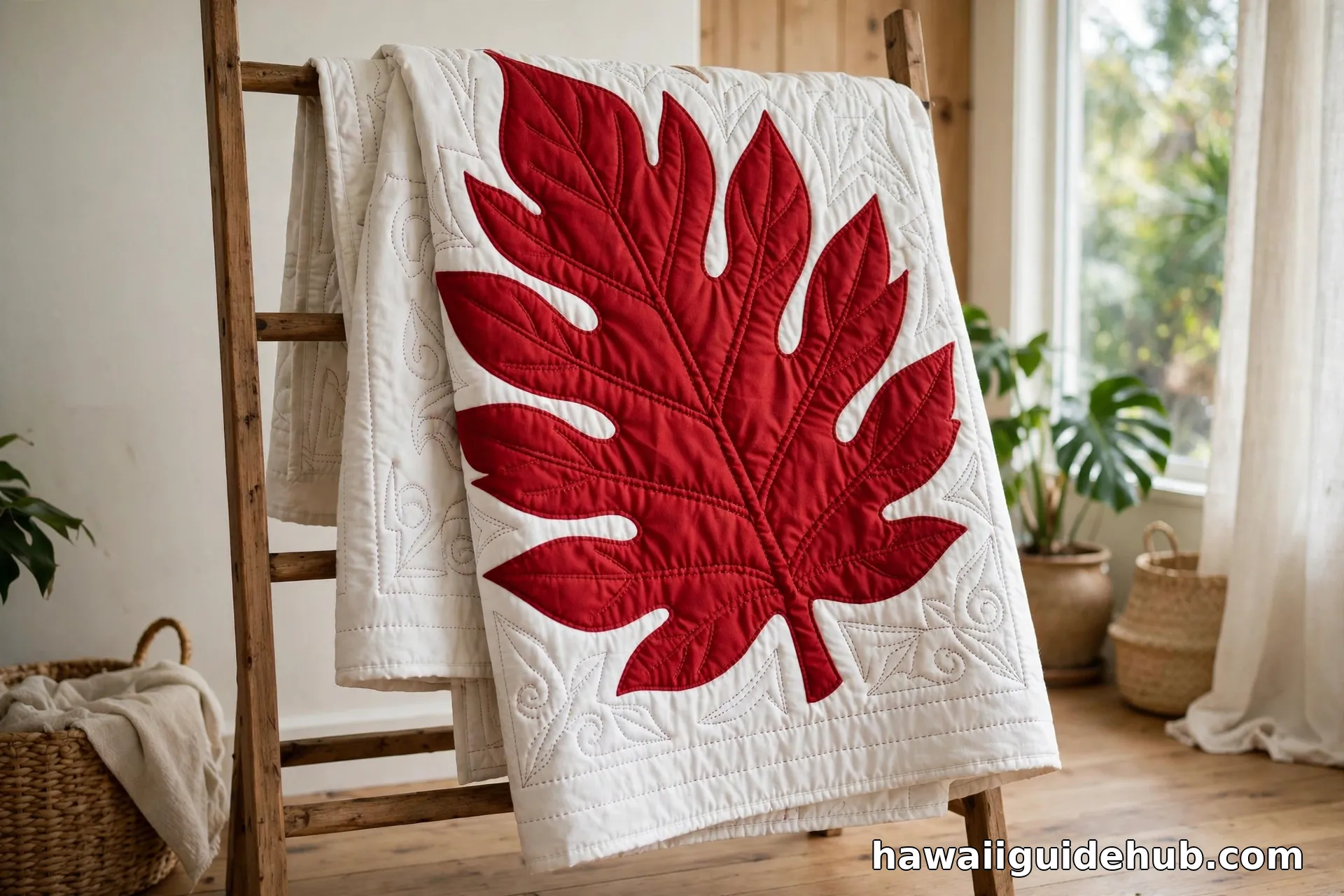
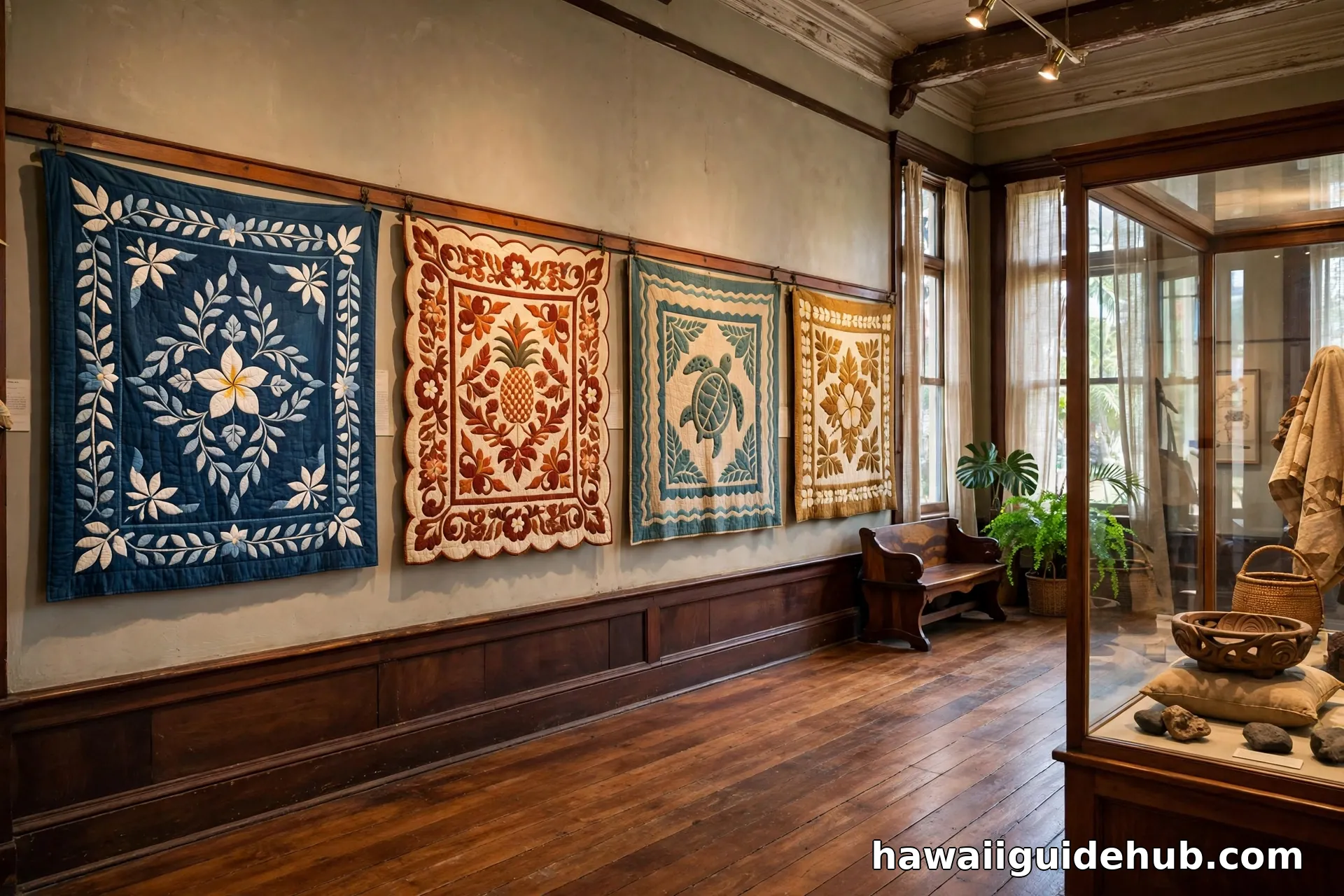
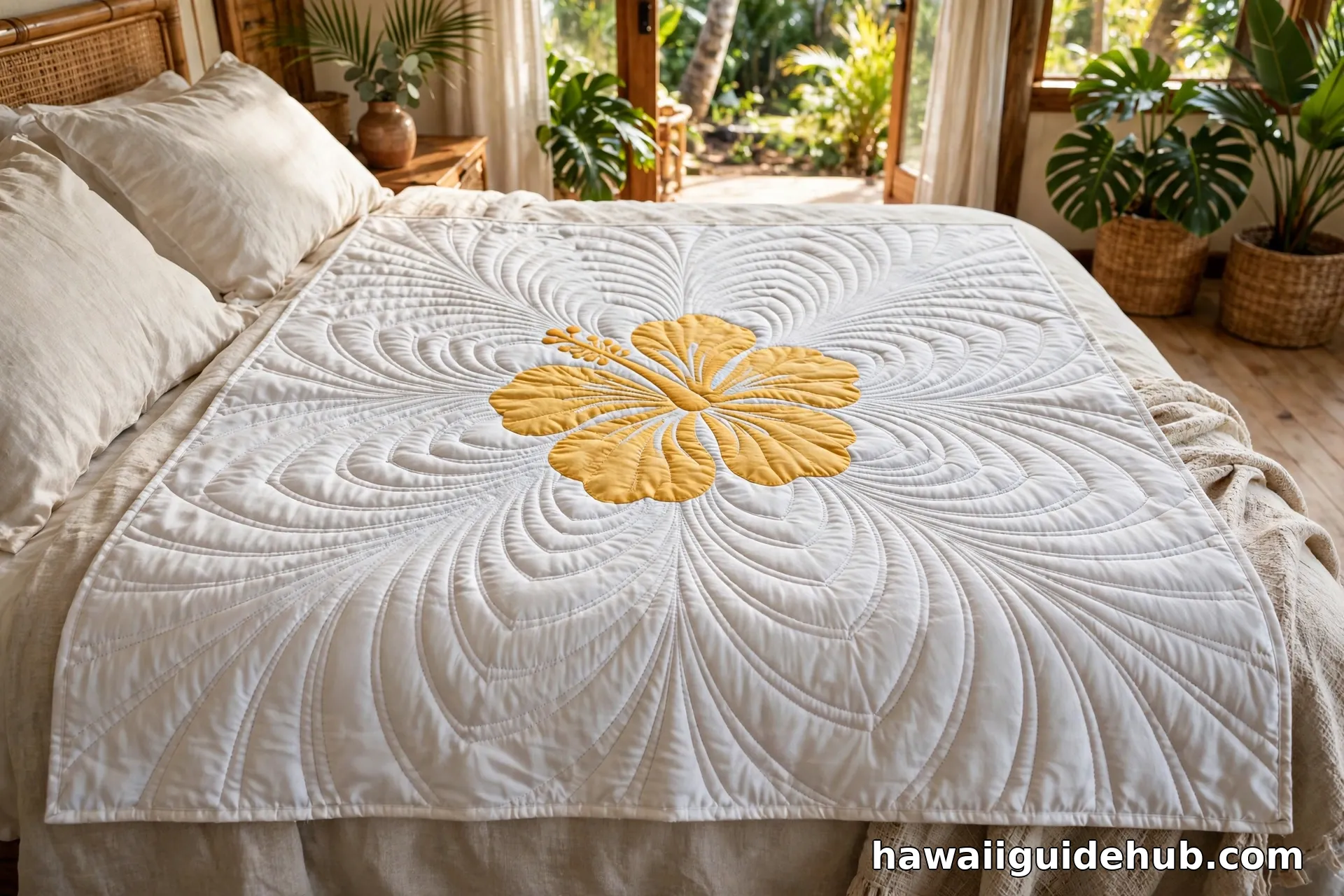
A Hawaiian quilt looks nothing like a mainland American patchwork quilt. Instead of dozens of small pieced squares, it is one enormous design, cut from a single piece of folded cloth, appliqued onto a background of a contrasting solid color. Unfold the cut piece and the design opens up like a paper snowflake: perfectly symmetrical, radiating from the center. The quilting stitches then follow the contours of the applique in echoing rows, which gives the surface its rippled, sculptural texture.
Traditional quilts use only solid fabrics, most classically a red design on a white ground, though historic quilts come in many color pairs. Motifs come from nature: ulu (breadfruit), hala kahiki (pineapple), hibiscus, plumeria, turtles, and rain. Later quilts add crowns and flags. A continuous lei border circles the design, representing the unbroken circle of life.
The Hawaiian name for the quilt is kapa kuiki, which ties it directly to the older bark cloth tradition. Hawaiians saw the quilt not as a foreign object but as the next chapter of a textile story already centuries old. To understand the quilt, start with the cloth it replaced.
Before the Quilt: The Kapa Cloth Tradition
Long before woven fabric reached the islands, Hawaiian women made cloth from the inner bark of the wauke, or paper mulberry, tree. This bark cloth is called kapa. Strips of bark were soaked and fermented, then beaten for hours with a carved wooden beater called an i’e kuku until the fibers fused into a soft sheet. The beater’s carved face left a watermark pattern in the cloth, and natural dyes from noni root, ‘olena, charcoal, and mud added color.
Kapa was everyday life: the pa’u skirt for women, the malo loincloth for men, the kihei cape for ceremony, and the layered kapa moe bed covering that quilts would later replace. When woven cotton arrived, Hawaiian women saw not a new craft but a new material for an old need.
The connection runs deeper than the name. The faint echo quilting stitches resemble the watermark a beater leaves on kapa, while the bold appliqued design recalls the stamped patterns of decorated kapa. The quilt carries the memory of bark cloth inside its stitches.
1820: Missionaries Bring Sewing to the Islands
The story begins with a ship. In March 1820, the brig Thaddeus arrived at Kawaihae on the Big Island with the first company of American missionaries from Boston. The missionaries’ wives brought woven fabric, steel needles, thread, and the New England tradition of patchwork quilting.
The women of the Hawaiian ali’i, the chiefly class, were curious. Missionary wife Lucy Thurston wrote in her journal on April 4, 1820, that Hawaiian women of rank came aboard the ship to a sewing circle, where they were given calico patchwork to sew. In the following years, missionary women taught sewing in their schools: piecing, darning, knitting, and patchwork quilt tops.
But the Hawaiian women found patchwork puzzling. Cutting beautiful cloth into small pieces only to sew it back together struck them as wasteful and strange. They learned the stitches and materials, then slowly made the technique their own. The Hawaiian quilt was not copied from the missionaries. It was invented by Hawaiian women who rebuilt a foreign craft around their own sense of beauty.
The Invention of the Hawaiian Applique Style
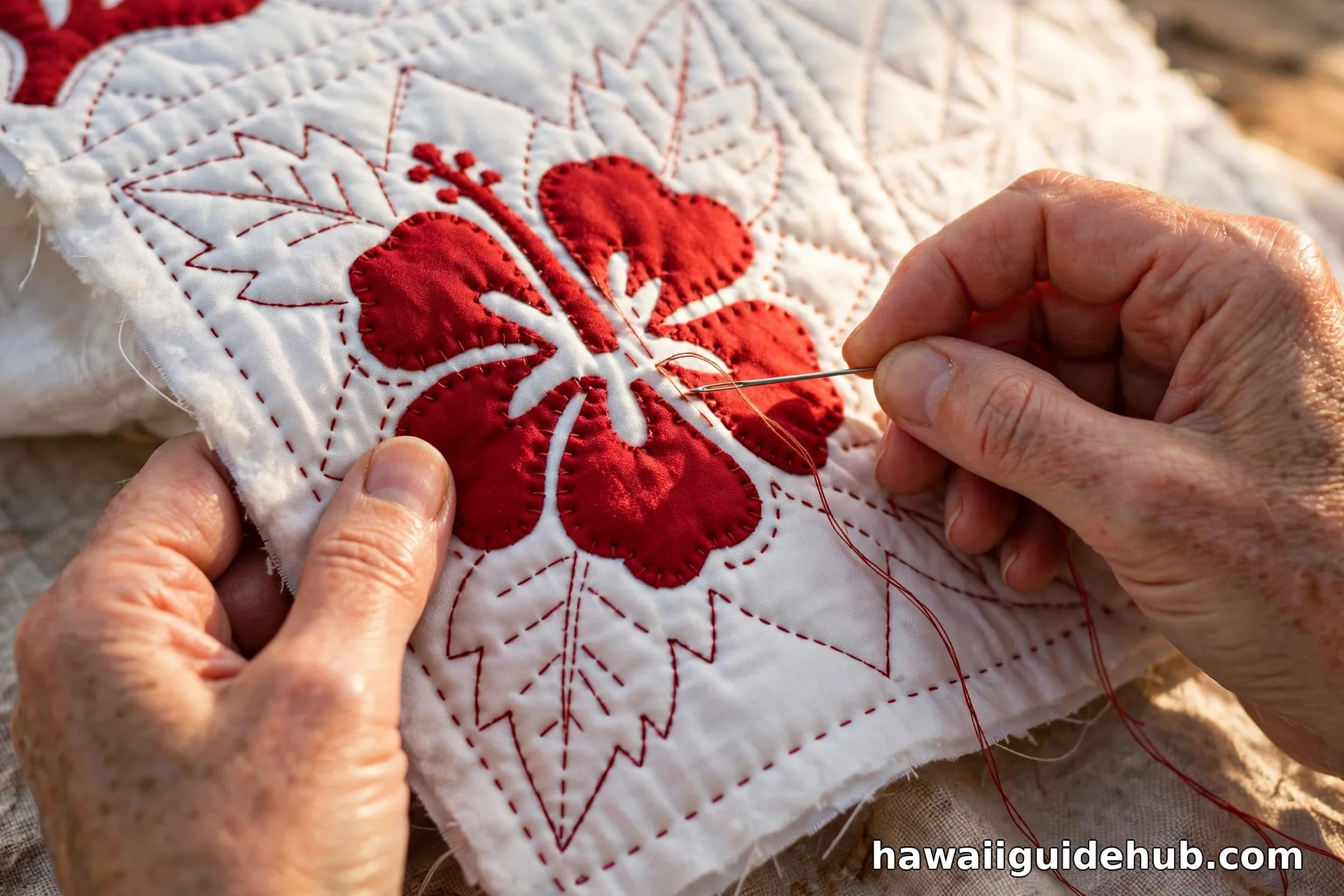
By the 1840s, the style we recognize as the traditional Hawaiian quilt had emerged. The quilter folded a whole bed sized piece of cloth into quarters or eighths, cut a single design the way a child cuts a paper snowflake, and appliqued it onto a contrasting ground with tiny, nearly invisible stitches. One cut produced the entire design, perfectly symmetrical and radiating from the center.
Quilters tell a beloved legend about the first design. Women had laid fabric on the grass to dry when they noticed the shadow of an ulu, or breadfruit, tree cast across it. They cut out that shadowy shape and appliqued it down. True or not, the story captures the spirit of the invention: Hawaiian quilting was born from translating the natural world into cloth.
The breadfruit pattern remains the most traditional of all Hawaiian quilt designs. Quilting teachers say the ulu should be the first pattern a quilter makes, because it ensures the quilter’s family will always have plenty of food. Breadfruit was one of the great staple foods of old Hawaii, and its broad, deeply lobed leaf makes a magnificent symmetrical design.
How a Traditional Hawaiian Quilt Is Made
Making a Hawaiian quilt the traditional way was a family and community affair. Three or four generations of women sat together around the quilt frame, stitching and telling stories, passing down family history along with the technique. The finished quilt carried the memory of everyone who worked on it.
The quilt has three layers: the appliqued top, batting, and backing. Early batting was a native Hawaiian fern; later, after sheep were introduced, wool became common. The top is cut from one piece of solid fabric and basted onto the ground cloth. Then comes the quilting: rows of tiny stitches, six to ten to the inch, echoing the applique contours again and again. A large quilt can hold hundreds of thousands of stitches and take many months to finish.
Master quilters describe the work as meditative and spiritual. One said she could not quilt when troubled, because the stitches would show it, and that quilts must be made with loving thoughts of the receiver. Many Hawaiians believe a quilt carries the mana, the spiritual energy, of its maker, which is why some quilters asked for their quilts to be burned when they died.
Royal Quilts and the Kingdom Era
Hawaiian quilting came of age during the Kingdom of Hawaii. A retainer of Queen Emma and King Kamehameha IV confirmed that women of the kingdom made their finest quilts to celebrate the birth of Prince Albert in 1858, presenting the infant prince with a stunning array of quilts made for births, weddings, and state occasions.
Quilts also became instruments of patriotism. The first Hawaiian flag quilt dates to 1843, when the islands were briefly under British control. Called Ku’u Hae Aloha, meaning “my beloved flag,” it turned the quilt into a statement of national identity. None of the earliest flag quilts survived, but the idea lived on.
A second wave of flag quilts came in the 1890s, after the 1893 overthrow of the monarchy and the 1898 annexation of Hawaii by the United States. Quilters combined the Hawaiian flag with crowns and royal symbols in quiet acts of resistance. An 1899 quilt of four upside down Hawaiian flags, the international signal of a country in distress, survives in the Bishop Museum.
The Meanings Hidden in the Patterns
Every element of a traditional quilt carries meaning. The ulu stands for plenty and should be quilted first. The hala kahiki, or pineapple, is the symbol of hospitality. Our guide to the flowers of Hawaii shows many blossoms, like hibiscus and plumeria, that appear as quilt motifs.
The continuous lei border represents the circle of life: unbroken even after death. The appliqued center stands for the core of the family, and the branches reaching outward represent growth. Quilts with no appliqued center, where the background shows through, represent the spiritual world, with the empty center as the gateway to the ancestors.
Traditionally, a quilter’s original pattern was personal property, guarded like a family treasure. Using someone else’s design without permission was considered a serious offense that could bring bad luck. The most authentic quilts were customized for their receivers, which is why each antique quilt feels so personal.
Queen Liliuokalani’s Prison Quilt
The most famous single Hawaiian quilt was made by Queen Liliuokalani herself. After the overthrow of the monarchy, she was imprisoned in ‘Iolani Palace in 1895. During her months of confinement, she pieced a quilt with her companions, stitching her loss and love for her nation into cloth. It remains one of the most moving artifacts of the kingdom era.
The Queen’s quilt shows how quilting had become, by the late nineteenth century, a deeply Hawaiian art rather than a missionary import. The technique arrived on the Thaddeus, but by the time Liliuokalani took up her needle, the quilt belonged to the culture completely.
The Twentieth Century Revival
Quilting faded during the early and mid twentieth century as the islands modernized. Then came the Hawaiian Renaissance of the 1970s, a broad cultural revival of hula, language, voyaging, and crafts. Quilting came back with it, carried by master quilters who taught, published patterns, and kept the old standards.
Among the most influential were Poakalani and John Serrao, whose 1977 book documented the symbolism of the designs for a new generation. Master quilters like Meali’i Kalama kept the handwork tradition alive at the highest level. The Hawaii Quilt Guild, founded in 1984 as Na Poe Humu Kuiki O Hawaii, gave quilters an organization for sharing the craft, and PBS Hawaii later documented the evolution from missionary sewing to echo quilting.
Today Hawaiian quilting is a living art. Classes are taught across the islands, contemporary quilters experiment with new motifs while honoring the old rules, and fine handmade quilts are treasured heirlooms. The tradition that began in 1820 now spans more than two centuries and is still growing.
Where to See Authentic Hawaiian Quilts
The best place to see historic Hawaiian quilts is Honolulu, where the tradition began. The Hawaiian Mission Houses Historic Site and Archives holds a remarkable collection of historic quilts from the cultural exchange that started it all. The Bishop Museum, with the largest collection of Native Hawaiian cultural objects in the world, includes the 1899 distress flag quilt. The Queen Emma Summer Palace, maintained by the Daughters of Hawaii, has exhibited rare kapa and quilts from the royal era.
Pair these museum visits with our deep dive into Hawaiian traditions, from hula to chanting and storytelling and our guide to cultural experiences and traditional luaus.
Respectful Visitor Etiquette
Hawaiian quilts are not just decorations. If you want to buy one, look for genuinely handmade work by local quilters rather than mass produced imports. Traditional quilters warn that factory made quilts carry no mana, no spirit, because they were made by strangers on machines. Buying from local makers supports the artists who keep the tradition alive.
Do not copy a traditional pattern and pass it off as your own. In Hawaiian quilting culture, original patterns belong to the quilter and her family, and using another design without permission is deeply disrespectful. In a quilting class, learn the technique and make your own original design.
In museums, remember that many historic quilts are fragile and some are considered to carry the spiritual presence of their makers. Follow photography rules, keep a respectful distance, and listen to the curators. A quilt made for a prince’s birth or stitched by an imprisoned queen deserves quiet attention.
Video: The Hawaii Quilt Guild
PBS Hawaii traces how missionary sewing in 1820 evolved into Hawaiian echo quilting.
Frequently Asked Questions
What is a Hawaiian quilt called?
A Hawaiian quilt is called a kapa kuiki, meaning the quilted kapa cloth. The name connects it to the older bark cloth tradition that quilts replaced as bed coverings.
When did Hawaiian quilting begin?
Quilting reached Hawaii with the first American missionaries, who arrived aboard the ship Thaddeus in March 1820. Missionary wives taught patchwork to Hawaiian women of the ali’i class, who then developed their own whole cloth applique style by the 1840s.
What is the most traditional Hawaiian quilt pattern?
The ulu, or breadfruit, pattern is the most traditional. Legend says the first Hawaiian quilt design was inspired by the shadow of a breadfruit tree on drying fabric. Teachers say the ulu should be a quilter’s first pattern, so her family always has plenty of food.
What do the designs on Hawaiian quilts mean?
Every design carries meaning. Breadfruit means plenty, pineapple means hospitality, the lei border represents the unbroken circle of life, the appliqued center stands for the family core, and an empty center represents the spirit world.
What is a Hawaiian flag quilt?
A Hawaiian flag quilt incorporates the Hawaiian flag, often with crowns and royal symbols. The first dates to 1843, during a brief period of British control, and was called Ku’u Hae Aloha, “my beloved flag.” A second wave followed the 1893 overthrow, when quilters used flag quilts as quiet expressions of patriotism.
Where can I see historic Hawaiian quilts?
The best collections are in Honolulu: the Hawaiian Mission Houses Historic Site and Archives, the Bishop Museum, and the Queen Emma Summer Palace all hold important historic quilts and regularly display them.
From a sewing circle aboard a ship in 1820 to a queen stitching in a palace prison, from bark cloth beaten with wooden mallets to applique cut like paper snowflakes, the Hawaiian quilt has carried the islands’ history in every stitch. It began as a foreign craft, became a Hawaiian art, served as a quiet flag of resistance, and lives on in the hands of quilters who still cut, baste, and stitch the old way. A Hawaiian quilt is never just a blanket. It is two hundred years of Hawaii, folded into cloth.