The Rainbow Trees of Hawaii: Where to See the Painted Eucalyptus

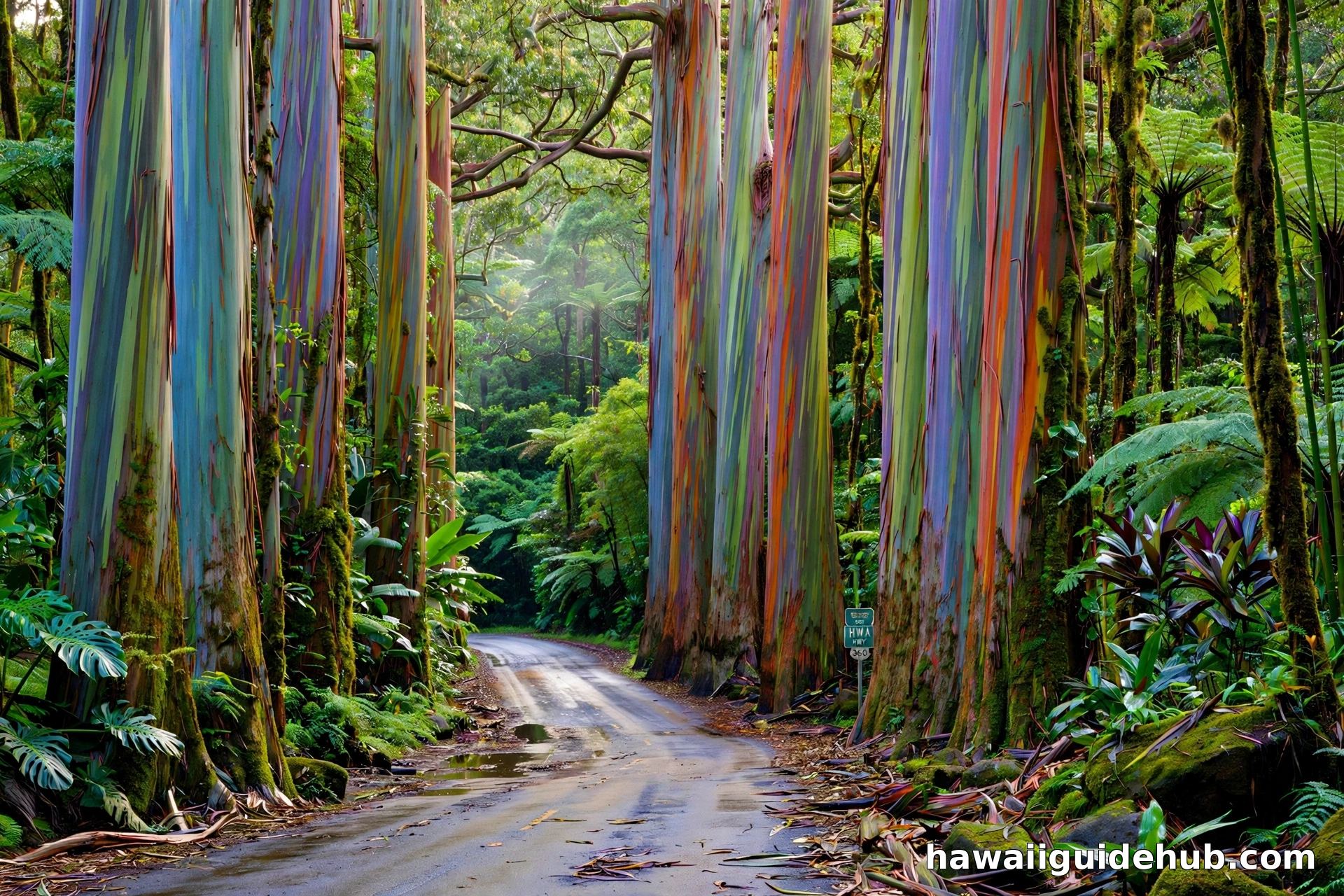
You are driving the Road to Hana on Maui, winding through rainforest so thick the light turns green, when the trees beside the road start to look wrong. Their trunks are streaked with blue and purple and orange, as if someone took a paintbrush to them in the night. You slow down. You pull over. You stare. Those are rainbow eucalyptus trees, and they are one of the strangest and most beautiful sights in all of Hawaii.
Nothing about them is painted, dyed, or faked. The colors come from the bark itself, peeling away in patches and aging through a whole spectrum as it meets the air. This is the only tree of its kind on the planet, and Hawaii is one of the few places in the United States where you can stand beneath it. Here is everything worth knowing about the rainbow tree of Hawaii: what it is, how it gets its colors, and exactly where to find it across the islands.
What Is the Rainbow Eucalyptus?
The rainbow eucalyptus is a real species with the scientific name Eucalyptus deglupta. It is also called Mindanao gum or rainbow gum, after the Philippine island of Mindanao where it grows wild. Its native range covers the Philippines, Indonesia, and Papua New Guinea, where it towers over lowland rainforests along rivers.
It holds a distinction no other eucalyptus can claim. Of the more than 700 eucalyptus species in the world, it is the only one that grows naturally in the northern hemisphere. Every other eucalyptus is native to Australia or nearby islands. The rainbow eucalyptus is the lone tropical rainforest member of a family otherwise built for dry Australian bush.
It is also one of the fastest growing trees on earth. In ideal conditions it can shoot up more than three feet in a single year, and mature trees reach 200 to 250 feet tall, with trunks several feet across. The leaves are long and lance shaped with the sharp, clean scent typical of eucalyptus. The flowers are small and white, easy to miss against the drama of the trunk.
How the Bark Gets Its Colors
The color is not in the wood. It is in the bark, and in the way the bark behaves.
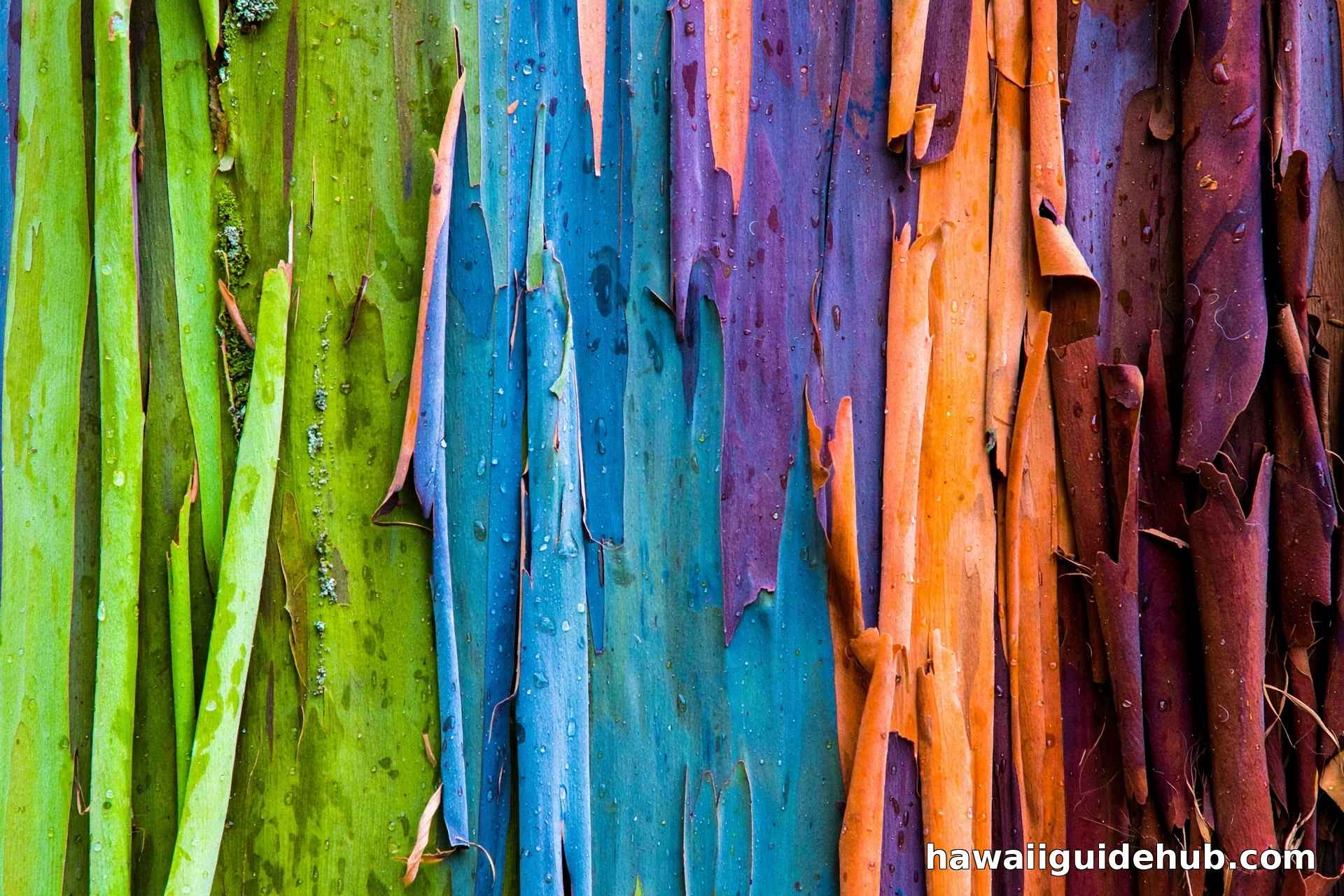
Most trees build up thick, corky bark that stays put for years. The rainbow eucalyptus does the opposite. Its outer bark is thin, and it sheds it constantly in long vertical strips and patches. Each patch falls away at a different time, so at any moment the trunk is a patchwork of bark at different ages.
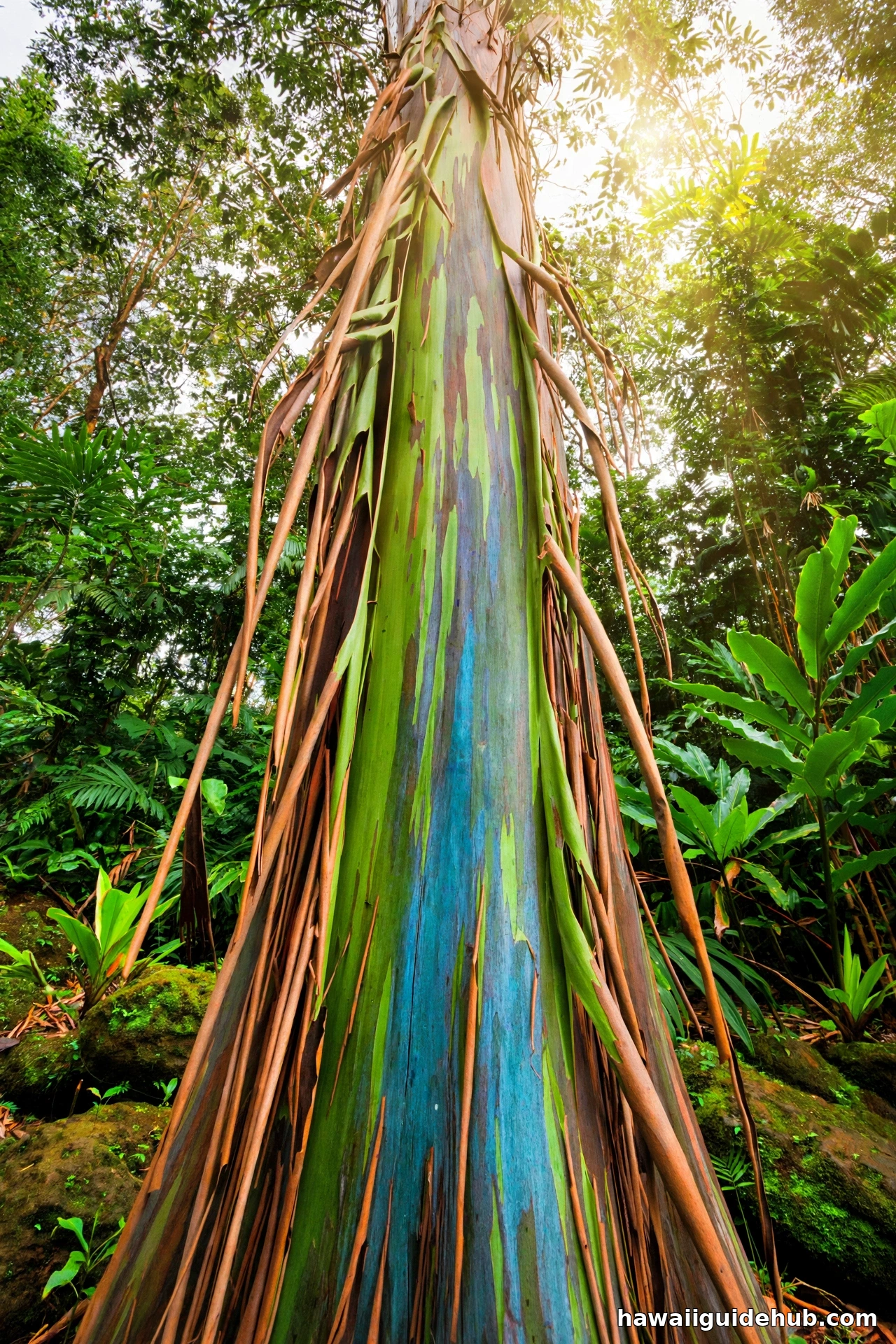
Where the bark has just peeled, the fresh inner layer is a vivid, almost neon green. As that new bark is exposed to air and sunlight, it slowly darkens and shifts: green deepens into blue, blue into purple, purple into orange and red, and finally into a deep maroon brown. By the time the whole trunk has cycled back to brown, new patches are already peeling and the show starts over.
This is why no two rainbow trees look alike, and why the same tree looks different from one visit to the next. The pattern depends on which patches peeled most recently, how much sun the trunk gets, and how wet the bark is. After a rain shower the colors glow noticeably brighter, which is why locals will tell you a drizzly morning is the best time to go looking. If you want to understand when it rains in Hawaii and plan your visit around the wet season, the trees will reward you for it.
Where to See Rainbow Eucalyptus Trees in Hawaii
Rainbow eucalyptus grows on several islands, but a few spots stand far above the rest. These are the places worth building into your plans.
Road to Hana, Maui: Mile Marker 6 to 7
The most famous grove in Hawaii stands just off the Hana Highway, a few miles past Paia. Somewhere around mile marker 6 or 7, keep your eyes on the left side of the road as you head toward Hana and you will see them: a stand of towering trunks striped like candy, rising out of the rainforest right beside the pavement.
This is the quick roadside stop, not the long visit. There is no formal parking lot, just a small dirt pullout that fits two or three cars, so arrive early in the day before the Hana traffic builds. The ground is usually muddy, and the famous red Maui dirt stains shoes, so wear footwear you do not mind ruining. Walk in among the trunks, look up at where the sun hits the fresh peels about ten to fifteen feet overhead, and take your photos. Ten minutes here will stay with you for years. If you are building a Maui itinerary, these trees pair naturally with the island’s other wonders, and there are plenty of reasons to visit Maui beyond the trees alone.
Keʻanae Arboretum, Maui: Mile Marker 16.7
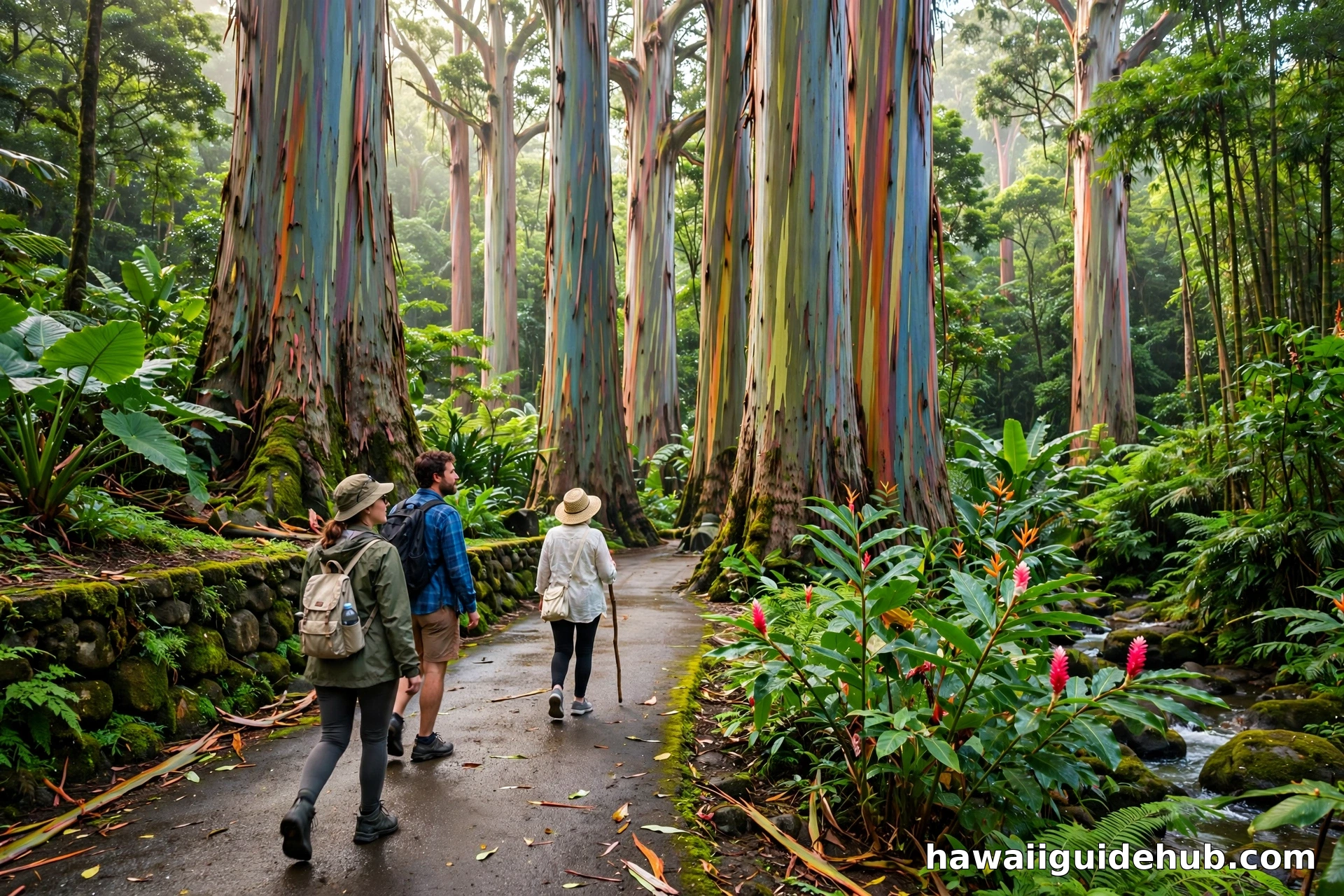
If the roadside grove is the quick look, Keʻanae Arboretum is the real experience. This free state park sits at mile 16.7 on the Hana Highway and holds some of the largest rainbow eucalyptus on Maui. A paved path winds through the garden, and you can walk right up to the trunks and touch the bark gently with your fingertips.
The arboretum is quieter than the roadside pullout and far safer, with no highway to dodge. The trees here are massive, and the garden setting means you see them the way they deserve to be seen: slowly, on foot, with time to notice how the colors change from trunk to trunk. Give it thirty to forty minutes. It is one of the true hidden gems across Hawaii that many Hana drivers rush straight past.
Wahiawa Botanical Garden, Oahu
Oahu has its own claim to the rainbow tree, and it is a historic one. The Wahiawa Botanical Garden in central Oahu holds more than 200 rainbow eucalyptus trees, planted beginning in 1957. This is the island where the species was first introduced to Hawaii back in 1929, so the Oahu trees carry the longest history.
The garden is a calm, shaded escape from the Honolulu crowds, and the eucalyptus grove is one of its highlights. Admission is free. Combine it with a broader day of exploring, and check our Oahu island adventure guide to round out the trip.
Keahua Arboretum, Kauai
On Kauai, head for Keahua Arboretum near Wailua on the island’s east side. More than 100 rainbow eucalyptus were planted here in the 1930s and 1940s along the river, and the mature grove is one of the loveliest on the island. The setting is wilder than a botanical garden, with the trees rising above the river valley.
Kauai rewards travelers who slow down, and the arboretum is an easy stop to fold into a day of sightseeing. For more ideas, browse our guide to the best things to do on Kauai.
Kaloko Drive, Big Island
The Big Island’s rainbow eucalyptus are the least famous of the bunch, which is part of their charm. Groves grow along Kaloko Drive near Kailua-Kona, on the dry leeward side of the island. They are not as tall or as dense as the Maui stands, but the bark colors show just as vividly, and you may have them entirely to yourself.
The Tree’s Journey to Hawaii
The rainbow eucalyptus is not native to Hawaii. It was first planted on the islands in 1929 at the Wahiawa Botanical Garden on Oahu, part of the territory’s early reforestation efforts. Foresters were looking for fast growing trees that could thrive in Hawaii’s wet windward valleys, and Eucalyptus deglupta, already prized in the tropics for pulpwood, fit the bill.
On Maui, the famous Road to Hana groves were planted decades later, and nobody has fully documented exactly who planted the mile marker 6 to 7 stand or precisely when. They simply appeared along the highway, grew with astonishing speed, and became a landmark. What began as a forestry experiment became one of the most photographed trees in the state.
Today the species is planted pantropically for pulpwood, and the wood it produces becomes the bright white paper used around the world. In Hawaii, though, its value is almost entirely ornamental. Nobody here is harvesting rainbow eucalyptus for timber. They are grown, protected, and visited for their beauty.
Rainbow Eucalyptus Facts at a Glance
Here are the essential facts about the tree, all in one place.
Tips for Visiting the Rainbow Trees
A little preparation turns a quick photo stop into a great memory. Keep these tips in mind.
Go in the morning. The light is softer, the crowds are thinner, and the bark colors photograph best before the harsh midday sun. At the Road to Hana grove, an early arrival also means a better chance at one of the few parking spots.
Do not skip a rainy day. This is the counterintuitive secret of the rainbow eucalyptus. Wet bark looks dramatically more vivid than dry bark, and a light rain makes the greens, blues, and purples glow. If it is drizzling, that is your cue to go, not to stay in the car.
Wear the right shoes. The ground beneath the groves is almost always muddy, and Maui’s red dirt is famous for permanently staining light colored footwear. Wear dark shoes with grip that you do not mind getting dirty.
Look up, not just ahead. The most intense colors are often ten to fifteen feet up the trunk, where the sun strikes the freshest peels. Tilt your camera upward and let the canopy frame the shot.
Be gentle with the bark. The peeling strips are delicate, and the trees at Keʻanae Arboretum and the botanical gardens are protected plantings. Touch lightly, never pull bark off, and stay on paths and pullouts rather than trampling the roots.
Watch the road. At the mile marker 6 to 7 grove you are parking on the shoulder of a narrow highway with steady traffic. Keep children close, stay off the pavement, and if the pullout is full, drive on to the arboretum instead of creating a hazard.
Bring the whole family. The rainbow trees are one of the rare Hana stops that ask nothing of small legs. There is no hike, no climb, and no admission fee. Kids love spotting which trunk has the most colors, and the groves make a perfect leg stretch break on the long drive. Just keep little ones close to you at the roadside pullout, where the highway traffic passes only a few feet away.
A Note on Invasive Species
It would not be honest to write about the rainbow eucalyptus in Hawaii without mentioning the other side of the story. Like many introduced plants, it can spread aggressively. The trees grow extraordinarily fast, drink large amounts of water, and can crowd out native vegetation where they naturalize. Conservationists in Hawaii list eucalyptus among the introduced species that need watching, particularly on the slopes of Haleakala on Maui.
This does not mean you should feel guilty for admiring them. The groves visitors see are planted stands in gardens, arboretums, and along a highway, not wild invasions of native forest. But it is worth knowing that the painted tree has a complicated ecological resume, and that Hawaii’s native forests, with their ʻōhiʻa lehua and koa, deserve the same admiration and protection.
Seeing the Painted Forest
The rainbow eucalyptus asks for nothing more than a few minutes of your attention, and it repays them many times over. Stand beneath one on a rainy morning on the Road to Hana, watch the colors shift as clouds move across the sun, and you will understand why travelers plan whole days around a tree. Hawaii has beaches and volcanoes and waterfalls in abundance, but it has only one painted forest, and it is waiting beside the road.