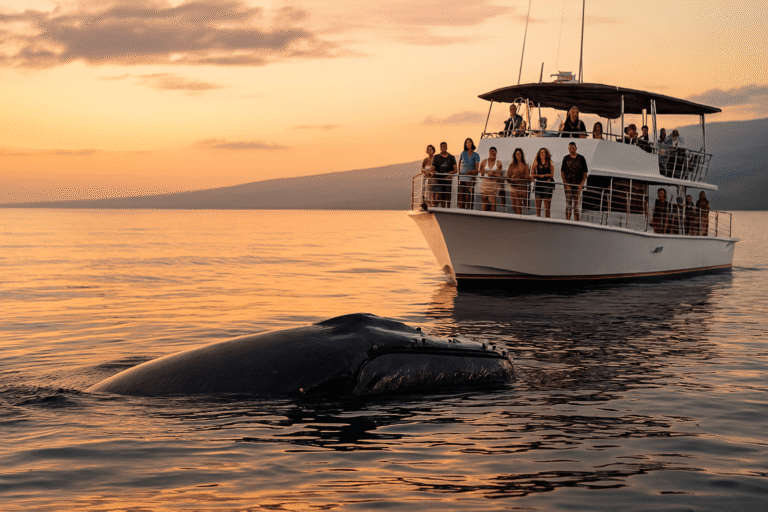
Understanding Humpback Whale Behaviour: What to Expect During Your Hawaii Adventure

Every year, the warm, protected waters of Hawaii become the setting for one of nature’s most amazing shows. Thousands of humpback whales travel from Alaska’s cold feeding grounds to the Hawaiian Islands to mate, give birth, and care for their young. Seeing these gentle giants is an experience you’ll never forget. Knowing how they act in complicated ways can make your whale watching trip even more special.
This guide helps you recognize visible humpback whale behaviors in Hawaiian waters and distinguish observation from interpretation. A breach, splash or song can be described clearly even when its exact purpose remains uncertain. Use the separate planning guides below for migration and viewing seasons.
Why Breeding-Season Context Matters
Many humpbacks travel between North Pacific feeding areas and Hawaiian breeding waters. The distance and timing vary among individuals. Our humpback migration guide explains that journey and how feeding and breeding habitats are connected.
Hawaii is an important winter breeding and calving area. That context helps explain observations of mothers with calves, singing males and competitive groups. It does not mean the surrounding ocean is always calm or that every whale you see is engaged in the same activity.
Decoding Humpback Behaviors: What You Might See
From shore, start by describing what moves above the surface: the head, a pectoral fin, the tail flukes or much of the body. NOAA’s behavior identification sheet illustrates several common movements. Their functions can overlap, and one short sighting rarely establishes a motive.
The Breach: A Spectacular Leap
The breach is probably the most popular thing to see when whale watching. This is when a humpback whale pushes its huge body, which can weigh up to 40 tons, almost completely out of the water before falling back down with a huge splash.
Why do whales breach?
There are a few different ideas that scientists have about what this strong behavior means:
- Communication: The splash creates sound, and signaling is one proposed function. The exact message cannot be read from a single breach.
- Development or play: These are possible explanations for some events, especially involving calves, rather than established motives for every leap.
- Getting rid of parasites: The forceful impact of landing could help dislodge barnacles and whale lice that attach to their skin.
- Uncertainty: Do not choose one explanation solely because it seems to fit a photograph.
Humpback whales can breach at different times. On some days, you might see several breaches in a short period, while on others, you might not see any. It often depends on how the whales in the area get along with each other.
The Tail Slap (Lobtailing)
In a tail slap, or lobtailing, a whale raises its flukes and strikes the surface. It may repeat the movement. This differs from lifting the flukes smoothly before a dive. Sound and social context may matter, but do not automatically interpret the slap as a warning directed at people.
The Slap of the Pectoral Fin
A pectoral-fin slap involves one or both long side fins striking the surface, sometimes while the whale rolls on its side or back. NOAA notes a possible communication role. Describe the movement without assuming that you know the intended recipient or message.
The Spyhop: A Strange Look
During a head rise or spyhop, a whale lifts its head vertically above the surface. This may allow it to look at activity above water, but it does not prove curiosity about a particular person. Continue observing from the appropriate distance.
The Head Lunge
A head lunge is a forward movement with the head raised above the surface, described by NOAA as a competitive display. Do not confuse the name with a feeding lunge simply because both involve forward movement.
The Peduncle Throw
A peduncle throw or slap involves the muscular tail stock and flukes moving out of the water and striking the surface. It can be dramatic, but should be identified by the movement rather than an assumed emotion.

Humpback Social Life: Mating and Giving Birth
Hawaiian breeding waters provide opportunities to observe social interactions, but much of the activity happens below the surface. Group composition can change, and proximity alone does not reveal the relationship between two animals.
Groups that compete
A competitive group may include several males associated with a female, with rapid movement and physical displays. An animal described as a primary escort is the male maintaining the closest association with her at that time. Avoid treating the label as evidence of a permanent family or protective partnership.
The Song of the Humpback
Male humpbacks produce patterned songs. Sanctuary researchers explain that the function remains debated, with evidence linking song to reproductive competition and interactions among males. It is too simple to say that every song is a direct call to attract a female.
Songs contain repeated units, phrases and themes, and change over time. Recordings made with a hydrophone reveal sound that a person watching from shore may not hear. A recording cannot by itself identify the visible whale as the singer without additional observation.
Mothers and Calves
A female humpback gives birth to a calf after a gestation of about 11 months. Calves nurse and remain closely associated with their mothers. An accompanying escort should not automatically be called the calf’s father or a bodyguard; those relationships cannot be established from a brief sighting.
Common Questions About How Whales Act
What if a whale is stranded or entangled?
A stranded whale is not displaying normal shore-viewing behavior. Disease, injury and other factors can contribute, and trained responders may need to investigate before a cause is known. Do not diagnose an animal from its location alone.
If you encounter a stranded, injured or entangled whale, respond as follows:
- Keep back: Leave room around the animal and keep people and pets away.
- Record the location: Note a nearby landmark and the animal’s position without approaching.
- Contact responders: Report what you can actually see rather than guessing why the animal is there.
- Do not intervene: Wait for trained responders and follow their instructions.
Call the NOAA Marine Wildlife Hotline at 888-256-9840 and provide the location and a description. Call 911 if people are in immediate danger. Do not attempt to push a whale back into the sea or remove entangling gear.
Do whales breach just for fun?
Play is one possible interpretation of some activity, particularly in young animals, but a single breach cannot establish that a whale is “having fun.” Record the action and its context without presenting speculation as a confirmed explanation.
Plan a Respectful Observation
Understanding the “what” and “why” behind humpback whale behavior transforms a whale watching trip from a simple sightseeing excursion into a profound connection with the natural world. Each splash and spout tells a story about the life, struggles, and triumphs of these gentle giants.
For when and where to look from land, read our Hawaii whale season and shore-viewing guide. To keep observations respectful, use the responsible whale-viewing guide.
Feeding behavior is a separate topic: our bubble-net feeding explanation distinguishes feeding grounds from the activities usually observed in Hawaii.
Use binoculars or a long lens instead of approaching an animal. Hawaii’s humpback approach rule requires at least 100 yards; apparent calm or an interesting behavior does not waive that restriction. See our tips for photographing whales in Hawaii for camera settings that work at a distance.