Portuguese Man O War in Hawaii: How to Identify Them and Treat Stings

The Portuguese man o war looks like a beautiful blue bubble floating on the waves, and it is one of the most painful things you can meet at a Hawaii beach. After strong onshore winds, thousands of them can strand along windward shores in a single day, their tentacles still able to sting hours after washing up. If you have been searching for anything about the Portuguese man o war in Hawaii, this is the one complete guide you need: what it is, how to identify it, which beaches see them, what to do if you are stung, and how to avoid them entirely.
Despite the name and the beach signs that call it a jellyfish, the Portuguese man o war is not a jellyfish at all. It is a siphonophore, a floating colony of four specialized organisms fused into one body that cannot survive apart. The form found in Hawaii is the smaller Pacific bluebottle, Physalia utriculus. Understanding what it is explains everything about where it goes and why it stings.
Portuguese Man O War at a Glance
| Know it | A siphonophore colony, not a true jellyfish; the Hawaiian form is Physalia utriculus (bluebottle). Translucent blue or pink gas-filled float with a crest sail; long blue tentacles trail beneath. The float is a few inches long; tentacles extend many feet below the surface. |
| Avoid it | Windward and east-facing beaches after strong onshore trade winds, year round; strandings can number in the thousands. Tentacles sting even when detached or washed up: never touch. |
| Treat it | Rinse with vinegar, then immerse in 113 F (45 C) hot water for 45 minutes. See a lifeguard; call 911 for breathing difficulty or severe spreading pain. |
What the Portuguese Man O War Actually Is
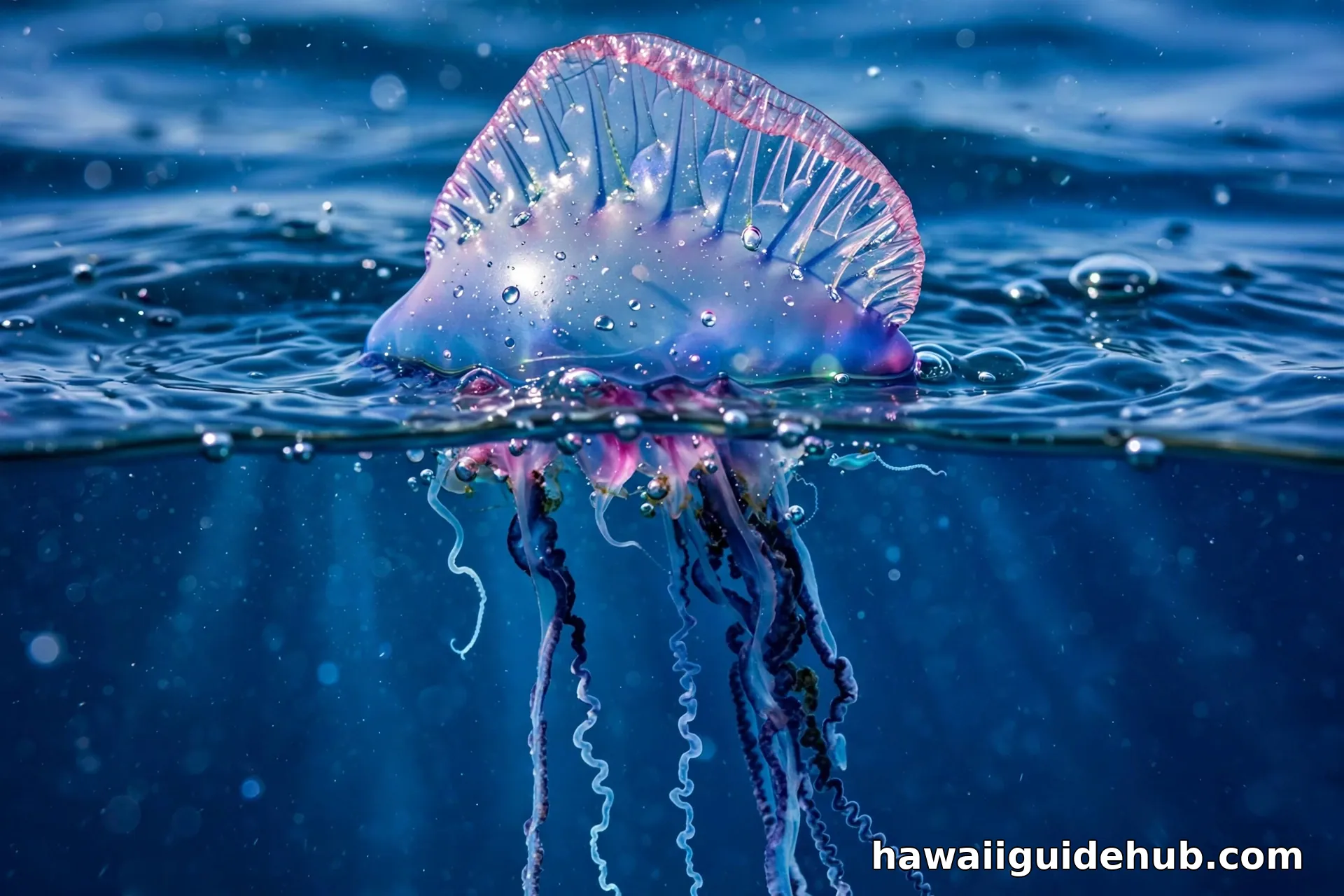
The Portuguese man o war is four animals in one. A gas-filled float called the pneumatophore keeps it at the surface. Beneath hang the dactylozooids, the long stinging tentacles that catch prey. Gastrozooids digest the catch, and gonozooids handle reproduction. All four bud from a single fertilized egg and are genetically identical, yet none can live without the others. It is a colony that has stopped being able to come apart.
The float carries a crest that works as a sail, and it comes in two mirror forms, left-handed and right-handed, which catch the same wind and drift in different directions. The animal cannot swim or steer. It goes exactly where wind and current take it. That is why strandings in Hawaii follow the wind so faithfully: when the trades blow hard onshore, the bluebottles sail straight onto windward beaches. They often arrive in groups, and a single windy week can push thousands of them onto the sand.
How to Identify One on the Beach or in the Water
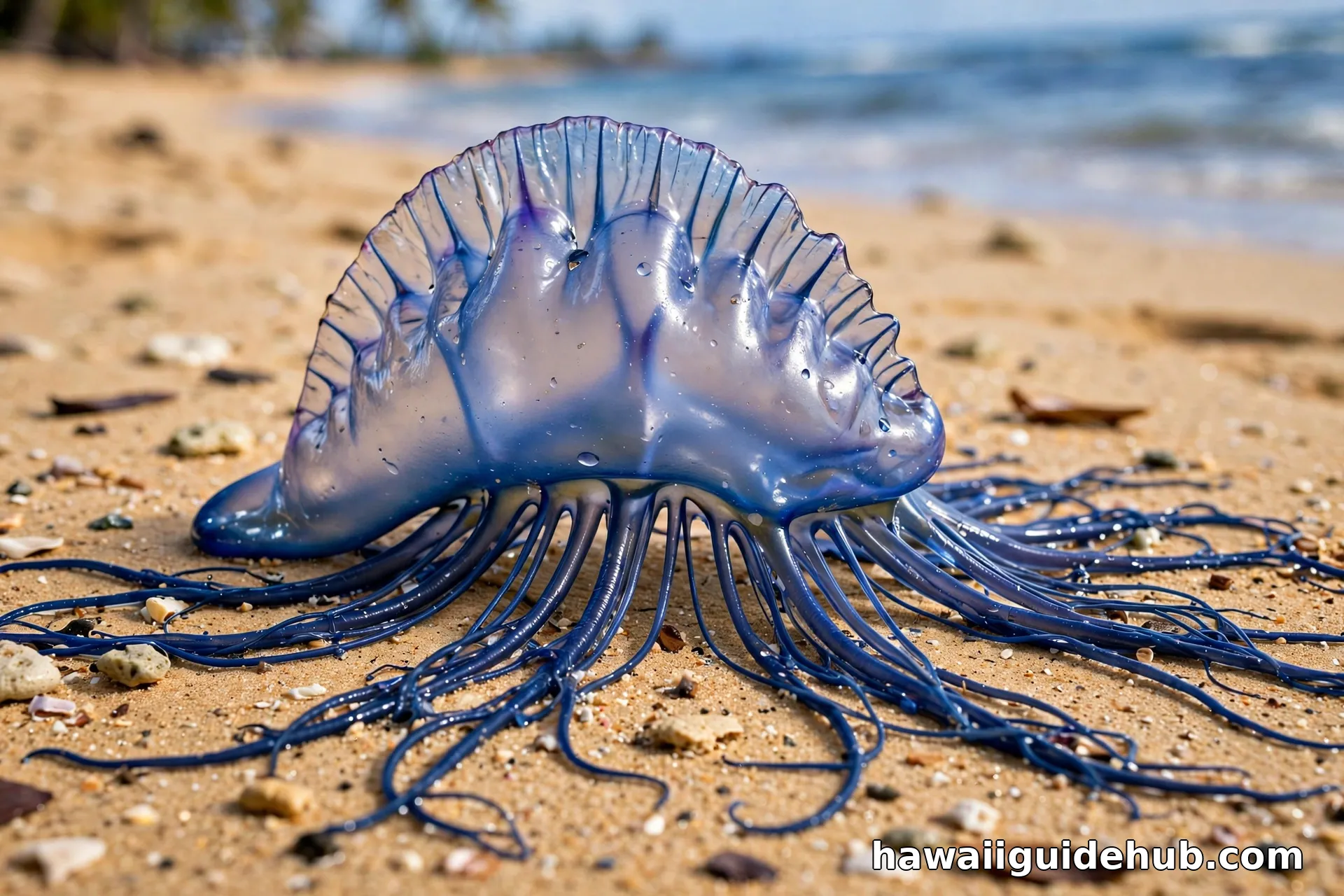
On the sand, a man o war looks like a small translucent bubble, often blue or violet with a pinkish ruffled crest on top, trailing a fringe of blue tentacle. In the water, you may see only the float riding the surface while the tentacles, which can extend many feet down, remain invisible. That invisibility is the real hazard. Swimmers are usually stung by tentacles they never saw.
Do not confuse it with the box jellyfish. Box jellies have a cube-shaped bell and arrive on south shore beaches on a lunar schedule. Man o war have a sail-like float, no bell, and arrive on windward beaches with the wind. The two animals need the same first aid, but they show up in different places for different reasons. If you are unsure which stung you, describe it to the lifeguard and let them identify it.
Man O War vs. Box Jellyfish: How to Tell Them Apart
Visitors often confuse these two animals, which is understandable since both can ruin a beach day and both need the same first aid. But they are completely different creatures with different habits, and knowing which is which tells you where to swim instead.
| Tell them apart by | Portuguese man o war | Box jellyfish |
| The body | Gas-filled float with a sail-like crest, no bell | Cube-shaped transparent bell |
| The schedule | Follows the wind, year round | Follows the moon, 8 to 12 days after full moon |
| The beach | Windward, east-facing shores | South-facing shores like Waikiki |
| On the sand | Blue bubble with tentacles; still stings | Clear cube, hard to spot |
| First aid | Vinegar, then 113 F water for 45 minutes | Vinegar, then 113 F water |
The practical difference is where you go to avoid them. During a box jellyfish influx window, the south shore is the problem and the windward side is the refuge. After strong trade winds, the pattern flips: windward beaches collect man o war while the south shore stays clear. Check both the moon and the wind, and you will almost always have a safe beach to choose.
Where Man O War Appear in Hawaii
Windward, east-facing shores take the brunt. On Oahu, that means Kailua, Lanikai, and the windward coast after strong trade wind episodes. Beaches facing the prevailing northeasterly trades anywhere in the islands can collect them when the wind blows hard for several days. Unlike box jellyfish, which follow the moon to the south shore, man o war follow the wind, so there is no calendar to check, only the weather.
After a stranding, the beach can be littered with them, and the tentacles remain venomous even when the animal is dead or dried on the sand. Dogs, children, and barefoot walkers are all at risk from stepping on or picking up a stranded specimen. If you see one blue bubble on the sand, assume there are more nearby, in the sand and in the water just offshore. Our guide to what to do on Oahu’s North Shore and Hanalei Beach on Kauai note which stretches face the wind and deserve extra caution after storms.

What a Sting Feels Like
A man o war sting brings immediate, intense burning pain. Long red whip-like welts rise along the path of the tentacle, with swelling that can last for hours. Victims often report muscle cramps, and the welts can leave marks that fade and return for weeks. Severe stings can cause headache, nausea, and in rare cases breathing difficulty or faintness, which need emergency care.
The venom is delivered by thousands of microscopic harpoons called nematocysts, the same mechanism box jellyfish use. And just like box jellyfish, most of those harpoons never fire on first contact, which means the way you treat the sting in the first minutes decides how much venom you ultimately receive.
How to Treat a Man O War Sting
For years, first aid guides treated man o war stings as a special case needing different treatment from other jellyfish. When University of Hawaii researchers dug into the evidence, they found almost nothing supporting that exception. Their study, published in the journal Toxins, concluded that man o war stings respond to the same treatment as other jellyfish stings.
Rinse with vinegar
Flood the sting with white vinegar. Vinegar stops unfired stinging cells from firing, which keeps the large reserve of venom still sitting on your skin from injecting. Do this before you try to remove tentacles.
Remove tentacles carefully
Pluck remaining tentacles with tweezers or lift them away with a card or stick. Do not rub the skin and do not touch tentacles with bare hands. Rinsing with seawater to wash tentacles away sounds natural, but the research found it spreads stinging cells to fresh skin and increases the venom load.
Immerse in hot water
Soak the sting in hot water at 113 degrees Fahrenheit (45 degrees Celsius) for 45 minutes, or apply a hot pack. The venom is highly heat sensitive, and heat consistently outperforms ice in studies. Test the water with an unaffected limb first so you do not scald the injury.
See a lifeguard after first aid. They handle these stings regularly and will judge whether you need further care. Call 911 for breathing difficulty, chest tightness, vision changes, or pain that keeps spreading. Keep the sting clean afterward and watch for signs of infection over the following days.
How to Avoid Man O War
There is no lunar calendar for man o war, but the wind is your forecast. After several days of strong onshore trade winds, expect strandings on windward beaches and swim elsewhere. Check with lifeguards before entering the water; they post warnings when bluebottles are washing in, and a two-minute conversation can save you a ruined beach day.
Teach children the rule that applies to every strange creature on a Hawaii beach: look, do not touch. A man o war on the sand looks like a toy bubble, which is exactly why kids pick them up. Scan the waterline before letting children play at the shore, and keep dogs leashed away from stranded specimens. For calmer leeward swimming options, see our Poipu Kauai guide and guided snorkel experiences in Kona, where professionals monitor conditions.

Man O War and Kids: What Parents Should Know
Children are the most common victims of stranded man o war because they are drawn to the pretty blue bubbles and they play at the waterline where tentacles wash up. The smaller the child, the more seriously a sting should be taken. After windy days, choose leeward beaches for family swim time, and walk the waterline yourself before the kids go in.
Show children a picture of a man o war before your beach days so they recognize one, and rehearse the response: come out of the water, tell an adult right away, do not rub it. A child who knows the plan stays calmer, and a calm child is easier to treat.
Video: The Portuguese Man O War Is Four Animals, Not One
This video explains why the Portuguese man o war is a colony of four organisms rather than a single jellyfish.
Frequently Asked Questions
Is a Portuguese man o war a jellyfish?
No. It is a siphonophore, a colony of four specialized organisms (float, tentacles, digestion, reproduction) that function as one animal but cannot survive apart. It is related to jellyfish but is a different kind of creature.
When do Portuguese man o war appear in Hawaii?
Year round, whenever strong onshore trade winds push them onto windward and east-facing beaches. There is no lunar schedule like box jellyfish. After several windy days, expect strandings, sometimes numbering in the thousands.
Can a dead Portuguese man o war still sting?
Yes. Tentacles remain venomous even when the animal is dead or dried on the sand, and detached tentacles in the water sting just as well as attached ones. Never touch a stranded man o war.
What is the best treatment for a man o war sting?
University of Hawaii research found the same treatment as other jellyfish stings works best: rinse with vinegar to stop unfired stinging cells, carefully remove tentacles, then immerse in 113 degree Fahrenheit (45 degree Celsius) hot water for 45 minutes. Do not use seawater rinses or ice.
Which Hawaii beaches get Portuguese man o war?
Windward and east-facing beaches after strong trade winds, such as Kailua and Lanikai on Oahu. Any beach facing the prevailing northeasterly trades can collect them during windy stretches. Leeward beaches are rarely affected.
Are Portuguese man o war stings dangerous?
They are intensely painful and can cause welts lasting weeks, but are rarely life threatening. Seek emergency care for breathing difficulty, faintness, or severe spreading pain, and take stings in small children especially seriously.
What should you do if you see man o war on the beach?
Do not touch them, and keep children and dogs away. Tell the lifeguard if the beach is guarded, since they may post a warning. If you were planning to swim there, choose a different beach, preferably on the leeward side, for the day. One stranded man o war usually means more are in the water nearby.
The Portuguese man o war is a wind-driven visitor, not a permanent resident of any beach, which means a little weather awareness goes a long way. Check the wind, ask the lifeguard, keep hands off the pretty blue bubbles, and know the vinegar and hot water routine. With those habits, this strange floating colony stays an interesting sight rather than a painful memory. For more help planning safe beach days, see our guide to the best island for first time visitors.