
Hawaii’s History Before the 50th Star: The Lost Kingdom

When you think of Hawaii, you might think of its beautiful beaches, lush volcanic landscapes, and the lively spirit of aloha. But there’s more to it than just being the 50th U.S. state. Its history is deep, complicated, and interesting. To really get Hawaii, you have to look back at its history, which is full of ancient travelers, powerful kingdoms, outside influences, and big changes. This article talks about Hawaii’s long and interesting history before it became a part of the United States.
For centuries, Hawaii was an independent nation, with its own unique culture, social structure, and political systems. The story of how a group of separate chiefdoms became a single kingdom and then a U.S. territory is one of strength, struggle, and identity. Knowing about this history helps you appreciate the Hawaiian Islands and the people who live there more. Let’s trace the pivotal moments that shaped Hawaii’s destiny.
Early Polynesian Settlements
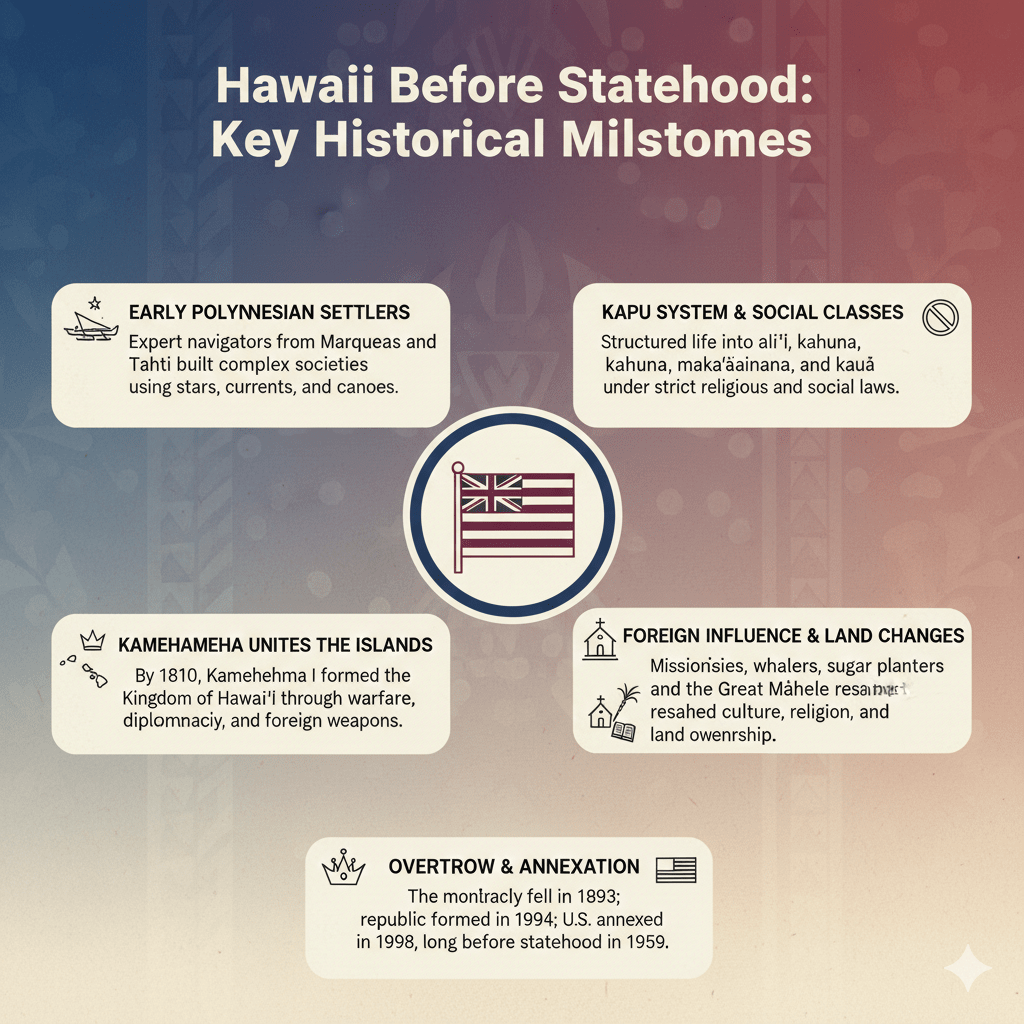
Polynesians, who were some of the best navigators in history, found and settled Hawaii long before any Western ships got there. Many people think that the first settlers came from the Marquesas Islands as early as 400 AD. These master sailors crossed thousands of miles of open ocean in double-hulled canoes, using only the stars, ocean currents, and the way birds flew to find their way.
These early settlers brought with them plants and animals that were necessary for survival, such as coconuts, bananas, chickens, pigs, and dogs. They built small, isolated communities, mostly on the coasts where there were a lot of resources. As the population grew, a second wave of people moving from Tahiti in the 11th or 12th century brought new ways of doing things, religious beliefs, and social hierarchies that would have a big impact on ancient Hawaiian society.
The Way Ancient Hawaiians Lived
The kapu system was a strict social structure that made up a highly organized and advanced society in ancient Hawaii. From religious ceremonies to managing resources to social interactions, this set of laws and rules controlled every part of daily life. It was made to keep things in order, save resources, and protect the power of the ruling class.
Hawaiian society was split into different classes:
- Aliʻi (Chiefs): The ruling class thought they were the descendants of the gods. Aliʻi nui were the highest-ranking chiefs, and they had complete control over their lands and people. Their power came from their family ties and their ability to make their communities rich.
- Kahuna (Priests and Experts): This respected group included priests, healers, and master craftsmen who were experts in things like canoe building, farming, and religious ceremonies. They were advisors to the aliʻi and were very important for the spiritual and practical health of the community.
- Makaʻāinana (Commoners): The biggest group, made up of farmers, fishermen, and workers. They worked on the land and in the sea, giving the whole community food and other things they needed. They didn’t own the land, but they could farm it and live on it in exchange for being loyal to and serving their chief.
- Kaua (Outcasts): A small group of people who were seen as different from the rest of society. They were often chosen to be human sacrifices for important religious ceremonies.
This well-organized society thrived for hundreds of years, creating a rich culture of hula, chant (oli), and storytelling (moʻolelo) that kept their history and values alive.
The Arrival of Captain Cook
On January 18, 1778, British explorer Captain James Cook and his crew saw the islands of Oahu and Kauai for the first time. This was the first record of Hawaii and the Western world coming into contact. In honor of his boss, the Earl of Sandwich, Cook named the islands the “Sandwich Islands.”
The arrival of Cook’s ships changed everything. The Hawaiians were first interested in the foreigners and their advanced technology, especially their weapons and tools made of metal. Hawaiians traded fresh food for iron goods, which started trade. But this contact also brought diseases like smallpox, measles, and influenza that the native people had no way to fight off. These diseases would kill a lot of people in Hawaii over the next hundred years, going from about 300,000 to 400,000 people to less than 40,000 by the 1890s. In 1779, Cook was killed in a fight at Kealakekua Bay on the island of Hawaii. This violent end to the first chapter of Western contact was very sad.
Hawaii as a Kingdom
After Captain Cook got there, the Hawaiian Islands were made up of chiefdoms that were at war with each other. Kamehameha, a powerful chief from Hawaii, saw the value of Western weapons and military strategies. He started a series of campaigns to unite the islands using guns and cannons he got from traders from other countries. He had taken over all of the Hawaiian Islands by 1810, using both war and diplomacy. This made the Kingdom of Hawaii.
King Kamehameha I, or Kamehameha the Great, was a great warrior and a wise leader. He established a centralized government, promoted trade, and maintained Hawaiian traditions while cautiously engaging with foreign powers. His rule brought a time of peace and prosperity, which set the stage for a unified Hawaiian nation that would last for almost a hundred years. The Hawaiian monarchy’s famous yellow, green, and red feather cloak is a symbol of this time of strong leadership. The flag of the Kingdom of Hawaii, which had the British Union Jack and stripes for the main islands, showed how the kingdom was trying to stay independent while still being influenced by other countries.
The Growth of Outside Power
After Kamehameha I died in 1819, American and European powers quickly gained more power. In 1820, Christian missionaries came to Hawaii with the goal of converting the people there. They brought Western education and a written Hawaiian language to Hawaii, but they also tried to stop traditional cultural practices like hula and the kapu system, which was officially ended soon after Kamehameha died.
At the same time, the islands became a vital port for the booming whaling industry and a center for sandalwood trade. Foreign businesspeople, mostly Americans, saw that the land could be used for farming. They started building big sugar plantations, which needed a lot of land and workers. This caused big changes in who owned land, and in 1848, the Great Māhele privatized land and let foreigners buy it. This event took away the ancestral lands of many native Hawaiians, giving a small group of foreign plantation owners a lot of economic power.
The End of the Monarchy
By the end of the 1800s, the Hawaiian monarchy’s power had greatly weakened. The sugar industry, dominated by American-born planters, held immense economic and political sway. This group made King Kalākaua sign the “Bayonet Constitution” in 1887. This took away most of the monarchy’s power and made it hard for many native Hawaiians to vote by requiring them to meet strict income and property requirements.
Queen Liliʻuokalani, Kalākaua’s sister, took the throne in 1891. She wanted to give the monarchy back its power and give her people the right to vote. She wrote a new constitution to take the place of the Bayonet Constitution, which was very unpopular. A group of American and European businessmen, with the help of U.S. Minister John L. Stevens and U.S. Marines, staged a coup because they were scared of this move. They got rid of the queen and ended the monarchy on January 17, 1893. Queen Liliʻuokalani gave up her power against her will to avoid bloodshed, hoping that the US government would see how wrong the act was and give her kingdom back.
The Republic and Annexation
After the coup, the conspirators set up a temporary government and immediately asked the United States to annex them. President Grover Cleveland, who was against imperialism, called the overthrow an illegal “act of war” and refused to annex the islands.
The provisional government then set up the Republic of Hawaii on July 4, 1894, with Sanford B. Dole, a well-known sugar planter, as its president. The Republic didn’t last long; it was mostly a temporary government until the U.S. became more open to annexation. The chance came when President William McKinley was elected and the Spanish-American War broke out in 1898. McKinley signed the Newlands Resolution on August 12, 1898, making Hawaii a U.S. territory without a vote or the consent of the native Hawaiian people. He saw Hawaii’s strategic location in the Pacific as important for military operations.
Hawaii became a U.S. territory
Hawaii was a part of the United States from 1898 to 1959. The sugar and pineapple industries continued to be the most important parts of the economy during this time. They were run by a small group of companies known as the “Big Five.” The population became more diverse as workers from Japan, China, the Philippines, and Portugal were brought in to work on the plantations.
A pivotal moment in this era was the attack on Pearl Harbor on December 7, 1941, which drew the United States into World War II. The attack made Hawaii the center of the conflict, and martial law was declared in the territory. The courage of Japanese-American soldiers in the 442nd Regimental Combat Team, even though they faced discrimination at home, helped fight against racism and make social and political change possible after the war.
A Legacy That Will Last
Hawaii’s path to statehood was long and complicated. It officially became the 50th U.S. state on August 21, 1959. But Hawaii’s past as a sovereign kingdom with a rich and vibrant culture still shapes who it is today. The islands are full of memories of the monarchy, the pain of the overthrow, and the strength of the Hawaiian people. Anyone who wants to really connect with Hawaii needs to know this history.
Are you ready to see for yourself the deep history and lively culture of Hawaii? Hawaii Guide Hub can help you plan a trip that goes deeper than just the surface. We can show you historical sites, cultural centers, and activities that honor the rich and interesting history of the Hawaiian Islands.


